Edinburgh Scotland
Edinburgh Scotland
Scotland
EUROPE
Yes
25
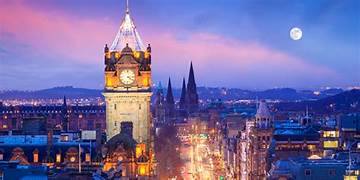
Scotland's capital, Edinburgh, is one of the country's thirty-two council districts. The Pentland Hills to the south and the Firth of Forth to the north enclose this southeast Scottish region. Edinburgh is the second most populated city in Scotland and the seventh most populous city in the United Kingdom, with 506,520 residents as of 2020. In the same year, there were 912,490 people living in the larger metropolitan area. The highest courts in Scotland, the Scottish Government, the Scottish Parliament, and the Palace of Holyroodhouse, the official residence of the British monarch in Scotland, are all located in Edinburgh, which has been acknowledged as the capital of Scotland since at least the 15th century. Additionally, the Church of Scotland's General Assembly meets there every year. For a long time, the city has been a hub for education, especially in the areas of engineering, medical, Scottish law, literature, philosophy, and the sciences. Founded in 1582, the University of Edinburgh is currently one of the city's three universities. The city is a hub for culture and is home to organizations like the Scottish National Gallery, the National Museum of Scotland, and the National Library of Scotland. The city is also well-known for the Fringe, the biggest annual international arts festival in the world, and the Edinburgh International Festival. Edinburgh Castle, the Palace of Holyroodhouse, St. Giles' Cathedral, Greyfriars Kirk, Canongate Kirk, and the vast Georgian New Town, constructed in the 18th and 19th centuries, are among the city's historic sites. Both the Old Town and the New Town are nominated by UNESCO as World Heritage Sites. Since 1999, Edinburgh World Heritage has been in charge of overseeing the site. With 5.3 million visitors in 2023, including 2.4 million from outside, the city's historical and cultural attractions have made it the second most popular tourist destination in Britain. Evidence of a Mesolithic camp site dating to approximately 8500 BC was discovered in Cramond, the earliest known human settlement in the Edinburgh region. On Castle Rock, Arthur's Seat, Craiglockhart Hill, and the Pentland Hills, remnants of later Bronze and Iron Age communities have been discovered. A Brittonic Celtic tribe known as the Votadini was discovered by the Romans when they landed in Lothian around the end of the first century AD.During the Early Middle Ages, the Votadini became part of the Gododdin kingdom, and one of its districts was Eidyn. The Castle Rock location, which is believed to have been Din Eidyn's stronghold, became the kingdom's main hub during this time.
Cape Town
Cape Town
South Africa
AFRICAN
Yes
35
South Africa's legislative capital is Cape Town. It is the oldest city in the nation and the location of the South African Parliament. Cape Town is the largest city in the Western Cape and the second most populous city in the nation, after Johannesburg.The city is a part of the metropolitan municipality known as the City of Cape Town.Table Mountain, Cape Point, the city's harbor, and its natural environment in the Cape Floristic Region are some of its most well-known features. Numerous publications have ranked Cape Town as the world's greatest city and the finest place to go, including Time Out in 2025, The New York Times in 2014, and The Telegraph for the last eight years (2017–2025). With the greatest concentration of Cape Dutch-style buildings worldwide, Cape Town is renowned for its architectural legacy. Constantia, the historic government buildings in the Central Business District, and Long Street are the best examples of the Cape Dutch architectural style, which blends the architectural traditions of the Netherlands, Germany, France, and Indonesia. Mostert's Mill in Mowbray is the only fully operational windmill in South Africa. Constructed in 1796, it underwent restorations in 1935 and 1995. In 2014, the International Council of Societies of Industrial Design declared Cape Town the World Design Capital. Additionally, Cape Town is designated a "Design City" by the Creative Cities Network of UNESCO. Cape Town's biggest performing arts facility is the Artscape Theatre Centre. The 17th-century savory, sweet, spiced beef dish known as bobotie is one of the foods that originated in Cape Town or is associated with it. A sandwich stuffed with slap chips and other toppings, the Gatsby was initially offered in the Athlone area in 1976 and has since come to represent the city.A classic Cape Malay dessert, the koe'sister is characterized as a cake-like dumpling flavored with cinnamon and topped with a dusting of desiccated coconut. Table Mountain's mass and the chilly Benguela Current of the South Atlantic Ocean both locally alter Cape Town's Mediterranean climate. While the average high temperature is 70°F (21°C) in January and February and the average low temperature is 55°F (13°C) in July, the coast and mountain slopes experience colder weather. Freezing rarely happens. Rainfall occurs on 69 days of the year on average; the southern winter months of June through August account for roughly half of the 26 inches (660 millimeters) of yearly rainfall. Every year, almost five million tons of goods pass through the port of Cape Town. Although ships with a draft of more than 40 feet are not permitted to enter the port during low tide, interoceanic commerce benefits greatly from its dry dock and maintenance facilities. Container traffic is accommodated at the Ben Schoeman Dock.


 (1).jpg)

.jpg)

.jpg)


.jpg)