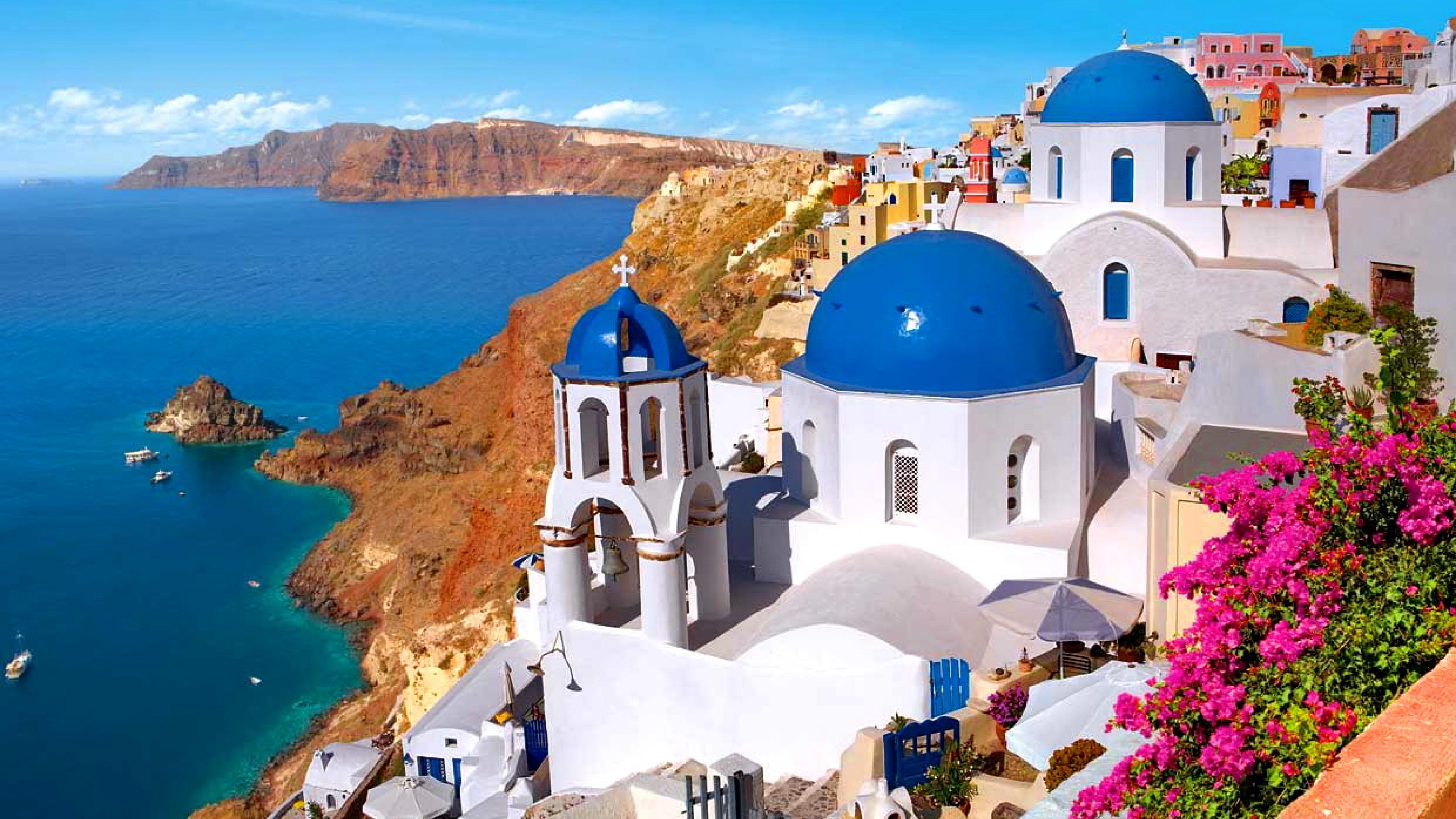
Santorini Greek Island, Greece
About 200 kilometers (120 miles) southeast of the mainland is the Greek island of Santorini, which is located in the southern Aegean Sea. The Santorini caldera created a small, circular archipelago of islands, of which this is the largest. It is the southernmost island in the Cyclades group, with an area of around 73 km2 (28 sq mi), and has 15,480 residents according to the 2021 census. The populated islands of Santorini and Therasia, as well as the uninhabited islands of Nea Kameni, Palaia Kameni, Aspronisi, Anydros, and Christiana, are all part of the municipality of Santorini. The entire land area is 35 square miles, or 91 km².Thira is the regional unit that includes Santorini. In the South Aegean Volcanic Arc, it is the most active volcanic center. The volcanic arc is roughly 20 to 40 km (12 to 25 mi) wide and 500 km (300 mi) long. Though volcanism on Thera started about 2 million years ago with the eruption of dacitic lavas from vents around Akrotiri, the region first experienced volcanic activity 3–4 million years ago. About 3,600 years ago, the island experienced one of the biggest volcanic eruptions in recorded history, leaving behind thick layers of volcanic ash and a sizable caldera filled with water. Like other Cyclades, Santorini's traditional architecture consists of low-lying cubical homes made of native stone that have been limewashed or whitewashed with different volcanic ashes to provide color. According to the island's traditional architecture, which was established up until the catastrophic earthquake of 1956, these colors have a tendency to replace white in the color of home façades in recent years. The distinctive feature is the widespread application of the hypóskapha, which are sideways or downward excavations of homes into the surrounding pumice. The Thira Autonomous Power Station, situated near Monolithos in the eastern region of Santorini, is the primary source of electricity for both Santorini and Therasia. It is owned by the Public Power Corporation (PPC) and features gas turbines and diesel engines for its generators. The combined installed capacity of the two islands is 0.25 MW of renewable energy and 75.09 MW of thermal energy. The Cyclades Interconnection Project is a €124 million initiative that aims to link the island to Naxos by an underwater cable and, eventually, to the mainland grid by 2023.The island's capital, Fira, is home to the main bus station, from which busses regularly depart. They cover the routes to the majority of tourist destinations and nearly every location on the island.
Early September to late October or late March to early June are the ideal times of year to visit Santorini. Compared to the busiest summer months, these months provide milder temperatures, less tourists, and more affordable costs. Winter (November to March) is the worst time to go because many attractions are closed and the weather is wetter and colder. Santorini is a beautiful destination in the spring, when the island comes alive with colorful flowers and pleasant weather. You may visit Oia's famous blue-domed churches, climb the picturesque Fira to Oia trail, and take leisurely vineyard tours without having to wait in line because it's less crowded than in the summer. The summer months are Santorini's busiest time of year, drawing tourists from all over the world. The island is a hive of activity, and its lively nightlife comes to life. This is the ideal time of year to visit Santorini's immaculate beaches, which include the tranquil Vlychada and the well-known Red Beach. In addition, summertime brings more people and more costs. Make sure to reserve lodging and activities far in advance. One of the season's highlights is the well-known Santorini Jazz Festival, which you should not miss. You may avoid the midday heat and take beautiful pictures in the early mornings and late evenings. Santorini becomes a golden paradise as summer draws to a close. As the island's vines come alive with grape harvests, the warm waters make September the perfect season for swimming. Wine lovers will enjoy learning about Santorini's volcanic wine heritage and taking part in tastings. When visiting Santorini, the average tourist spends $289 (€250) each day. Based on other travelers' costs, this represents the typical daily cost of a Santorini holiday. On average, previous visitors have spent one day: The average cost of a two-person trip to Santorini lasts $4,053 (€3,500) for one week.If you are a citizen of a nation that is a member of the European Union or the Schengen Area, you do not need a visa to enter Santorini or any other area of Greece. Today, the 27 European countries that comprise the Schengen Area have abolished passport restrictions at their shared borders. Before departing, nationals of nations such as China, Nigeria, South Africa, Russia, Pakistan, India, and others must apply for a Schengen visa. Entry is not always guaranteed, though, even if you have a Schengen Visa, as border guards may still request proof of the trip's purpose and financing source. If you are a citizen of a nation that is a member of the European Union or the Schengen Area, you do not need a visa to enter Santorini or any other area of Greece. Today, the 27 European countries that comprise the Schengen Area have abolished passport restrictions at their shared borders. Before departing, nationals of nations such as China, Nigeria, South Africa, Russia, Pakistan, India, and others must apply for a Schengen visa. Entry is not always guaranteed, though, even if you have a Schengen Visa, as border guards may still request proof of the trip's purpose and financing source. Of all the Greek islands, Santorini is arguably the most well-known, but it's worth following the crowds to discover why. It's difficult not to be mesmerized by this Cycladic superstar from the moment you see its towering, jagged cliffs from the ferry, topped by dazzling white villages and lapped by deep-blue water that fills a massive, sunken volcanic crater below. With good reason, Santorini is a famous honeymoon location in Europe. The deep-blue Aegean Sea and whitewashed blue-domed buildings provide a dreamlike setting, and the northern settlement of Oia provides exquisite sunset views. There are lots of options for outdoor eating, high on the hilltops with those breathtaking views once more, as well as for relaxing on the beach, going on a private boat excursion, or visiting a posh spa. Try Pelekanos, which offers mouthwatering seafood and breathtaking views of the caldera. If not, visit Character, a chic Italian eatery featuring wines that have won awards. With good reason, Santorini is a famous honeymoon location in Europe. The deep-blue Aegean Sea and whitewashed blue-domed buildings provide a dreamlike setting, and the northern settlement of Oia provides exquisite sunset views. There are lots of options for outdoor eating, high on the hilltops with those breathtaking views once more, as well as for relaxing on the beach, going on a private boat excursion, or visiting a posh spa. Try Pelekanos, which offers mouthwatering seafood and breathtaking views of the caldera. If not, visit Character, a chic Italian eatery featuring wines that have won awards. Santorini's sunsets, which are frequently rated as some of the greatest in the world, are among its most celebrated attractions. Every nightfall, tourists swarm to Santorini to witness the sky change into a rainbow of hues, from the cliffs of Oia to the summit of Imerovigli. It is very magical how the light interacts with the caldera, illuminating the surrounding terrain with shades of pink, orange, and deep purple. You can fall in love with Greek cooking by trying these seven of Santorini's most well-known dishes. We've gone above and above to make your search easier by offering a few recommended locations where you may sample each delicious treat. Have fun with your food, Kali oreksi. 1. Fritters with tomatoes from Santorini 2. Greek salad, also known as Santorinian salad 3. Fava beans 4. White Eggplant from Santorini 5. Cheese with Chloro 6. Katsounia, or Santorini cucumber 7. Pasted tomatoes from Santorini Located in the village of Kamari, Santorini (Thira) International Airport (JTR), often referred to as Thira Airport, offers daily flights from nearby Athens and locations throughout Europe. Olympic Air, Aegean Airlines, and AirSea Lines all offer frequent flights from Athens. Connections to Rhodes, Mykonos, and Crete (Heraklion) are also offered in the summer. Astra Airlines operates flights from Thessaloniki throughout July and August. Santorini and the new port of Athinios are connected by frequent ferry service from Piraeus port in Athens. In peak season, there is also a daily connection between Santorini and Heraklion, Crete. Athens' Piraeus Port's Gate E8 is where ferries to Santorini leave. A high-speed ferry travels 4.5 hours from Piraeus to Santorini. Ferries might take up to eight hours on average. Although they are quicker than traditional ferries, high-speed boats can cost more.
 (1).jpg)
 (1).jpg)
.jpg)
.jpg)
 (1).jpg)
 (1).jpg)
.jpg)
.jpg)
.jpg)






