Edinburgh Scotland
Edinburgh Scotland
Scotland
EUROPE
Yes
25
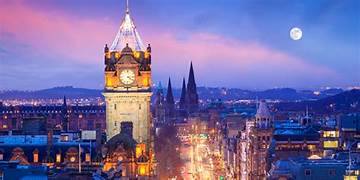
Scotland's capital, Edinburgh, is one of the country's thirty-two council districts. The Pentland Hills to the south and the Firth of Forth to the north enclose this southeast Scottish region. Edinburgh is the second most populated city in Scotland and the seventh most populous city in the United Kingdom, with 506,520 residents as of 2020. In the same year, there were 912,490 people living in the larger metropolitan area. The highest courts in Scotland, the Scottish Government, the Scottish Parliament, and the Palace of Holyroodhouse, the official residence of the British monarch in Scotland, are all located in Edinburgh, which has been acknowledged as the capital of Scotland since at least the 15th century. Additionally, the Church of Scotland's General Assembly meets there every year. For a long time, the city has been a hub for education, especially in the areas of engineering, medical, Scottish law, literature, philosophy, and the sciences. Founded in 1582, the University of Edinburgh is currently one of the city's three universities. The city is a hub for culture and is home to organizations like the Scottish National Gallery, the National Museum of Scotland, and the National Library of Scotland. The city is also well-known for the Fringe, the biggest annual international arts festival in the world, and the Edinburgh International Festival. Edinburgh Castle, the Palace of Holyroodhouse, St. Giles' Cathedral, Greyfriars Kirk, Canongate Kirk, and the vast Georgian New Town, constructed in the 18th and 19th centuries, are among the city's historic sites. Both the Old Town and the New Town are nominated by UNESCO as World Heritage Sites. Since 1999, Edinburgh World Heritage has been in charge of overseeing the site. With 5.3 million visitors in 2023, including 2.4 million from outside, the city's historical and cultural attractions have made it the second most popular tourist destination in Britain. Evidence of a Mesolithic camp site dating to approximately 8500 BC was discovered in Cramond, the earliest known human settlement in the Edinburgh region. On Castle Rock, Arthur's Seat, Craiglockhart Hill, and the Pentland Hills, remnants of later Bronze and Iron Age communities have been discovered. A Brittonic Celtic tribe known as the Votadini was discovered by the Romans when they landed in Lothian around the end of the first century AD.During the Early Middle Ages, the Votadini became part of the Gododdin kingdom, and one of its districts was Eidyn. The Castle Rock location, which is believed to have been Din Eidyn's stronghold, became the kingdom's main hub during this time.
Kruger National Park Africa
Kruger National Park Africa
Africa
AFRICAN
Yes
37
Covering 19,623 km2 (7,576 sq mi), Kruger National Park is located in the northeastern South African provinces of Mpumalanga and Limpopo. It stretches 65 km (40 mi) from east to west and 360 km (220 mi) from north to south. Skukuza is home to the administrative headquarters. The South African Republic's government first protected portions of the park in 1898, and in 1926 it was designated as the country's first national park. It is a part of the biosphere reserve known as the Kruger to Canyons Biosphere. Kruger National Park is home to all five of the big game creatures and boasts 147 species of large mammals, more than any other game reserve in Africa. Webcams have been installed to watch the wildlife. There are believed to be just 400 African wild dog packs in all of South Africa, and Kruger is home to packs of these endangered animals. There is a reasonably consistent group of bird species from the park's southern to central regions, but the mopane-dominated flatlands north of the Olifants show a fall in richness.The larger birds of prey, on the other hand, breed during the dry winter, when their prey is most exposed, whereas the majority of species breed during the summer, when rainfall sustain the majority of vegetable and animal food. In 1918, Kruger National Park was declared, and a commission was formed to oversee its development and planning. A government officer named Johannes Andries (Dries) de Ridder served as the commission's first secretary. After 44 years in charge of the Kruger Park, Warden James Stevenson-Hamilton retired on April 30, 1946. Colonel J. A. B. Sandenbergh of the South African Air Force took his post. The government forcibly removed the Makuleke people from the northern portion of the park in 1969, and approximately 1500 of them were relocated to territory in the south so that their original tribal lands could be incorporated into the larger Kruger National Park. The famed Big Five (lion, leopard, elephant, rhinoceros, and buffalo) are among the remarkably diverse species that makes Kruger National Park famous. The park, which spans about two million hectares, draws tourists from all around the world with its unmatched wildlife viewing opportunities.


 (1).jpg)

.jpg)

.jpg)


.jpg)