Edinburgh Scotland
Edinburgh Scotland
Scotland
EUROPE
Yes
25
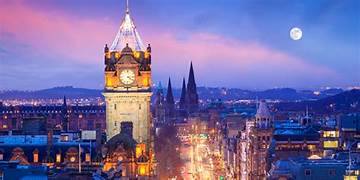
Scotland's capital, Edinburgh, is one of the country's thirty-two council districts. The Pentland Hills to the south and the Firth of Forth to the north enclose this southeast Scottish region. Edinburgh is the second most populated city in Scotland and the seventh most populous city in the United Kingdom, with 506,520 residents as of 2020. In the same year, there were 912,490 people living in the larger metropolitan area. The highest courts in Scotland, the Scottish Government, the Scottish Parliament, and the Palace of Holyroodhouse, the official residence of the British monarch in Scotland, are all located in Edinburgh, which has been acknowledged as the capital of Scotland since at least the 15th century. Additionally, the Church of Scotland's General Assembly meets there every year. For a long time, the city has been a hub for education, especially in the areas of engineering, medical, Scottish law, literature, philosophy, and the sciences. Founded in 1582, the University of Edinburgh is currently one of the city's three universities. The city is a hub for culture and is home to organizations like the Scottish National Gallery, the National Museum of Scotland, and the National Library of Scotland. The city is also well-known for the Fringe, the biggest annual international arts festival in the world, and the Edinburgh International Festival. Edinburgh Castle, the Palace of Holyroodhouse, St. Giles' Cathedral, Greyfriars Kirk, Canongate Kirk, and the vast Georgian New Town, constructed in the 18th and 19th centuries, are among the city's historic sites. Both the Old Town and the New Town are nominated by UNESCO as World Heritage Sites. Since 1999, Edinburgh World Heritage has been in charge of overseeing the site. With 5.3 million visitors in 2023, including 2.4 million from outside, the city's historical and cultural attractions have made it the second most popular tourist destination in Britain. Evidence of a Mesolithic camp site dating to approximately 8500 BC was discovered in Cramond, the earliest known human settlement in the Edinburgh region. On Castle Rock, Arthur's Seat, Craiglockhart Hill, and the Pentland Hills, remnants of later Bronze and Iron Age communities have been discovered. A Brittonic Celtic tribe known as the Votadini was discovered by the Romans when they landed in Lothian around the end of the first century AD.During the Early Middle Ages, the Votadini became part of the Gododdin kingdom, and one of its districts was Eidyn. The Castle Rock location, which is believed to have been Din Eidyn's stronghold, became the kingdom's main hub during this time.
Maasai Mara Africa
Maasai Mara Africa
Africa
AFRICAN
Yes
38
Maasai Mara, frequently spelled Masai Mara, and referred to locals as just "The Mara," is a sizable national game reserve in Kenya's Narok County that borders Tanzania's Serengeti National Park. The Maasai people, the region's original occupants who came from the Nile Basin, are honored by the name. From a distance, their description of the region is as follows: "Mara" means "spotted" in the Maa language due to the short, bushy trees that are scattered throughout the terrain. With its populations of lions, leopards, cheetahs, and African bush elephants, the Maasai Mara is one of Africa's wilderness and wildlife protection areas. In addition, it is home to the Great Migration, which has earned it a spot among the ten Wonders of the World and the Seven Natural Wonders of Africa. Depending on the weather, the Great Migration often takes place in July when a huge number of wildebeest migrate from Tanzania across the Mara River. The Maasai Mara National Reserve, the Mara Triangle, a number of Maasai group ranches, and Maasai Mara conservancies are all included in the Greater Mara ecosystem. The Masai Mara, sometimes referred to as "the world's eight world wonders" or one of the most well-known wildlife places in the world, is home to an abundance of species, breathtaking views, and unending plains.The Masai Mara National Reserve, an unfenced reserve with unrestricted wildlife movement, and a number of conservancies comprise the Greater Masai Mara area. Maasai families privately own these parcels of land. The Maasai families who lease their property to safari lodges have the opportunity to use the money they make from the conservancies to fund development or education projects in their communities. The Masai Mara was called in honour of the Maasai people, the traditional residents of the area. 'Mara' means'spotted' in Maasai (Maa) dialect. It won't be difficult to comprehend how the Masai Mara gained its name after visiting. The terrain does appear somewhat'spotted' due to the small, bushy trees that dot it. The environment of the Greater Masai Mara is enormous. It is almost 1510 square kilometers in size. The Serengeti National Park in Tanzania is adjacent to the Maasai Mara, a sizable game reserve in Narok County, Kenya. It is named after the Maasai people, who were the original occupants of the region, and how they described it from a distance: "Mara" means "spotted" in the Maasai language, referring to the numerous trees, plants, cloud shadows, and animals that dotted the terrain.


 (1).jpg)

.jpg)

.jpg)


.jpg)