Machu Picchu
Machu Picchu
South America
SOUTH AMERICA
Yes
18
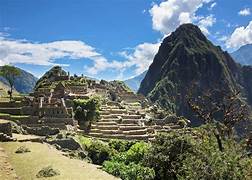
"The most well-known symbol of the Inca Empire is Machu Picchu, a 15th-century Inca citadel situated 2,430 meters (7,970 feet) above sea level on a mountain crest in southern Peru's Eastern Cordillera. It is situated 80 kilometers (50 miles) northwest of Cusco in the Machupicchu District of the Urubamba Province, above the Sacred Valley. By slicing through the Cordillera and forming a canyon with a subtropical mountain climate, the Urubamba River flows past it. In 1982 and 1983, respectively, Machu Picchu was designated a Peruvian Historic Sanctuary and a UNESCO World Heritage Site.In a global online survey conducted in 2007, Machu Picchu was selected as one of the New Seven Wonders of the World. From the late 16th century until the 19th century, no Europeans are known to have visited the site after the first encounter by the Spanish soldier Baltasar Ocampo. The Inca society lacked a written language. To the best of our knowledge, there are no written documents that describe the location when it was in use. The most popular theory holds that Incan royalty used Machu Picchu as a private city. Based on tangible evidence, such as tombs at the site, modern archaeologists have come up with names for the buildings, their purported purposes, and their occupants. Machu Picchu was constructed with polished dry-stone walls in the traditional Inca style. The Temple of the Sun, the Temple of the Three Windows, and the Intihuatana are its three main buildings.
Kruger National Park Africa
Kruger National Park Africa
Africa
AFRICAN
Yes
37
Covering 19,623 km2 (7,576 sq mi), Kruger National Park is located in the northeastern South African provinces of Mpumalanga and Limpopo. It stretches 65 km (40 mi) from east to west and 360 km (220 mi) from north to south. Skukuza is home to the administrative headquarters. The South African Republic's government first protected portions of the park in 1898, and in 1926 it was designated as the country's first national park. It is a part of the biosphere reserve known as the Kruger to Canyons Biosphere. Kruger National Park is home to all five of the big game creatures and boasts 147 species of large mammals, more than any other game reserve in Africa. Webcams have been installed to watch the wildlife. There are believed to be just 400 African wild dog packs in all of South Africa, and Kruger is home to packs of these endangered animals. There is a reasonably consistent group of bird species from the park's southern to central regions, but the mopane-dominated flatlands north of the Olifants show a fall in richness.The larger birds of prey, on the other hand, breed during the dry winter, when their prey is most exposed, whereas the majority of species breed during the summer, when rainfall sustain the majority of vegetable and animal food. In 1918, Kruger National Park was declared, and a commission was formed to oversee its development and planning. A government officer named Johannes Andries (Dries) de Ridder served as the commission's first secretary. After 44 years in charge of the Kruger Park, Warden James Stevenson-Hamilton retired on April 30, 1946. Colonel J. A. B. Sandenbergh of the South African Air Force took his post. The government forcibly removed the Makuleke people from the northern portion of the park in 1969, and approximately 1500 of them were relocated to territory in the south so that their original tribal lands could be incorporated into the larger Kruger National Park. The famed Big Five (lion, leopard, elephant, rhinoceros, and buffalo) are among the remarkably diverse species that makes Kruger National Park famous. The park, which spans about two million hectares, draws tourists from all around the world with its unmatched wildlife viewing opportunities.


 (1).jpg)

.jpg)

.jpg)


.jpg)