Machu Picchu
Machu Picchu
South America
SOUTH AMERICA
Yes
18
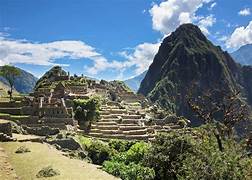
"The most well-known symbol of the Inca Empire is Machu Picchu, a 15th-century Inca citadel situated 2,430 meters (7,970 feet) above sea level on a mountain crest in southern Peru's Eastern Cordillera. It is situated 80 kilometers (50 miles) northwest of Cusco in the Machupicchu District of the Urubamba Province, above the Sacred Valley. By slicing through the Cordillera and forming a canyon with a subtropical mountain climate, the Urubamba River flows past it. In 1982 and 1983, respectively, Machu Picchu was designated a Peruvian Historic Sanctuary and a UNESCO World Heritage Site.In a global online survey conducted in 2007, Machu Picchu was selected as one of the New Seven Wonders of the World. From the late 16th century until the 19th century, no Europeans are known to have visited the site after the first encounter by the Spanish soldier Baltasar Ocampo. The Inca society lacked a written language. To the best of our knowledge, there are no written documents that describe the location when it was in use. The most popular theory holds that Incan royalty used Machu Picchu as a private city. Based on tangible evidence, such as tombs at the site, modern archaeologists have come up with names for the buildings, their purported purposes, and their occupants. Machu Picchu was constructed with polished dry-stone walls in the traditional Inca style. The Temple of the Sun, the Temple of the Three Windows, and the Intihuatana are its three main buildings.
Cape Town
Cape Town
South Africa
AFRICAN
Yes
35
South Africa's legislative capital is Cape Town. It is the oldest city in the nation and the location of the South African Parliament. Cape Town is the largest city in the Western Cape and the second most populous city in the nation, after Johannesburg.The city is a part of the metropolitan municipality known as the City of Cape Town.Table Mountain, Cape Point, the city's harbor, and its natural environment in the Cape Floristic Region are some of its most well-known features. Numerous publications have ranked Cape Town as the world's greatest city and the finest place to go, including Time Out in 2025, The New York Times in 2014, and The Telegraph for the last eight years (2017–2025). With the greatest concentration of Cape Dutch-style buildings worldwide, Cape Town is renowned for its architectural legacy. Constantia, the historic government buildings in the Central Business District, and Long Street are the best examples of the Cape Dutch architectural style, which blends the architectural traditions of the Netherlands, Germany, France, and Indonesia. Mostert's Mill in Mowbray is the only fully operational windmill in South Africa. Constructed in 1796, it underwent restorations in 1935 and 1995. In 2014, the International Council of Societies of Industrial Design declared Cape Town the World Design Capital. Additionally, Cape Town is designated a "Design City" by the Creative Cities Network of UNESCO. Cape Town's biggest performing arts facility is the Artscape Theatre Centre. The 17th-century savory, sweet, spiced beef dish known as bobotie is one of the foods that originated in Cape Town or is associated with it. A sandwich stuffed with slap chips and other toppings, the Gatsby was initially offered in the Athlone area in 1976 and has since come to represent the city.A classic Cape Malay dessert, the koe'sister is characterized as a cake-like dumpling flavored with cinnamon and topped with a dusting of desiccated coconut. Table Mountain's mass and the chilly Benguela Current of the South Atlantic Ocean both locally alter Cape Town's Mediterranean climate. While the average high temperature is 70°F (21°C) in January and February and the average low temperature is 55°F (13°C) in July, the coast and mountain slopes experience colder weather. Freezing rarely happens. Rainfall occurs on 69 days of the year on average; the southern winter months of June through August account for roughly half of the 26 inches (660 millimeters) of yearly rainfall. Every year, almost five million tons of goods pass through the port of Cape Town. Although ships with a draft of more than 40 feet are not permitted to enter the port during low tide, interoceanic commerce benefits greatly from its dry dock and maintenance facilities. Container traffic is accommodated at the Ben Schoeman Dock.


 (1).jpg)

.jpg)

.jpg)


.jpg)