Machu Picchu
Machu Picchu
South America
SOUTH AMERICA
Yes
18
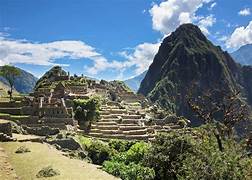
"The most well-known symbol of the Inca Empire is Machu Picchu, a 15th-century Inca citadel situated 2,430 meters (7,970 feet) above sea level on a mountain crest in southern Peru's Eastern Cordillera. It is situated 80 kilometers (50 miles) northwest of Cusco in the Machupicchu District of the Urubamba Province, above the Sacred Valley. By slicing through the Cordillera and forming a canyon with a subtropical mountain climate, the Urubamba River flows past it. In 1982 and 1983, respectively, Machu Picchu was designated a Peruvian Historic Sanctuary and a UNESCO World Heritage Site.In a global online survey conducted in 2007, Machu Picchu was selected as one of the New Seven Wonders of the World. From the late 16th century until the 19th century, no Europeans are known to have visited the site after the first encounter by the Spanish soldier Baltasar Ocampo. The Inca society lacked a written language. To the best of our knowledge, there are no written documents that describe the location when it was in use. The most popular theory holds that Incan royalty used Machu Picchu as a private city. Based on tangible evidence, such as tombs at the site, modern archaeologists have come up with names for the buildings, their purported purposes, and their occupants. Machu Picchu was constructed with polished dry-stone walls in the traditional Inca style. The Temple of the Sun, the Temple of the Three Windows, and the Intihuatana are its three main buildings.
Cairo Africa
Cairo Africa
Cairo
AFRICAN
Yes
38
Cairo isn’t just the capital of Egypt — it’s the pulse of the nation. A city where ancient history meets modern chaos, where the call to prayer rises above the traffic, and where every alley seems to hum with life. Home to over 10 million people, Cairo is one of the biggest and most energetic cities in the Middle East and Africa. It’s a place of contrasts — the timeless Pyramids of Giza just a short drive from bustling markets, rooftop cafés, and shiny new malls. The Greater Cairo Metropolitan Area, with more than 22 million residents, is among the most populated urban regions on Earth. Surrounded by ancient sites like Memphis, Heliopolis, and the Giza Plateau, Cairo is a living bridge between Egypt’s past and its future. The city’s origins trace back to Fustat, Egypt’s first Islamic capital founded in 641 CE, and later to 969 CE, when the Fatimid dynasty created what we now call Cairo. Through centuries — under the Ayyubids, Mamluks, and beyond — the city became Egypt’s heart of architecture, art, and learning.
.jpg)

 (1).jpg)
.jpg)




.jpg)