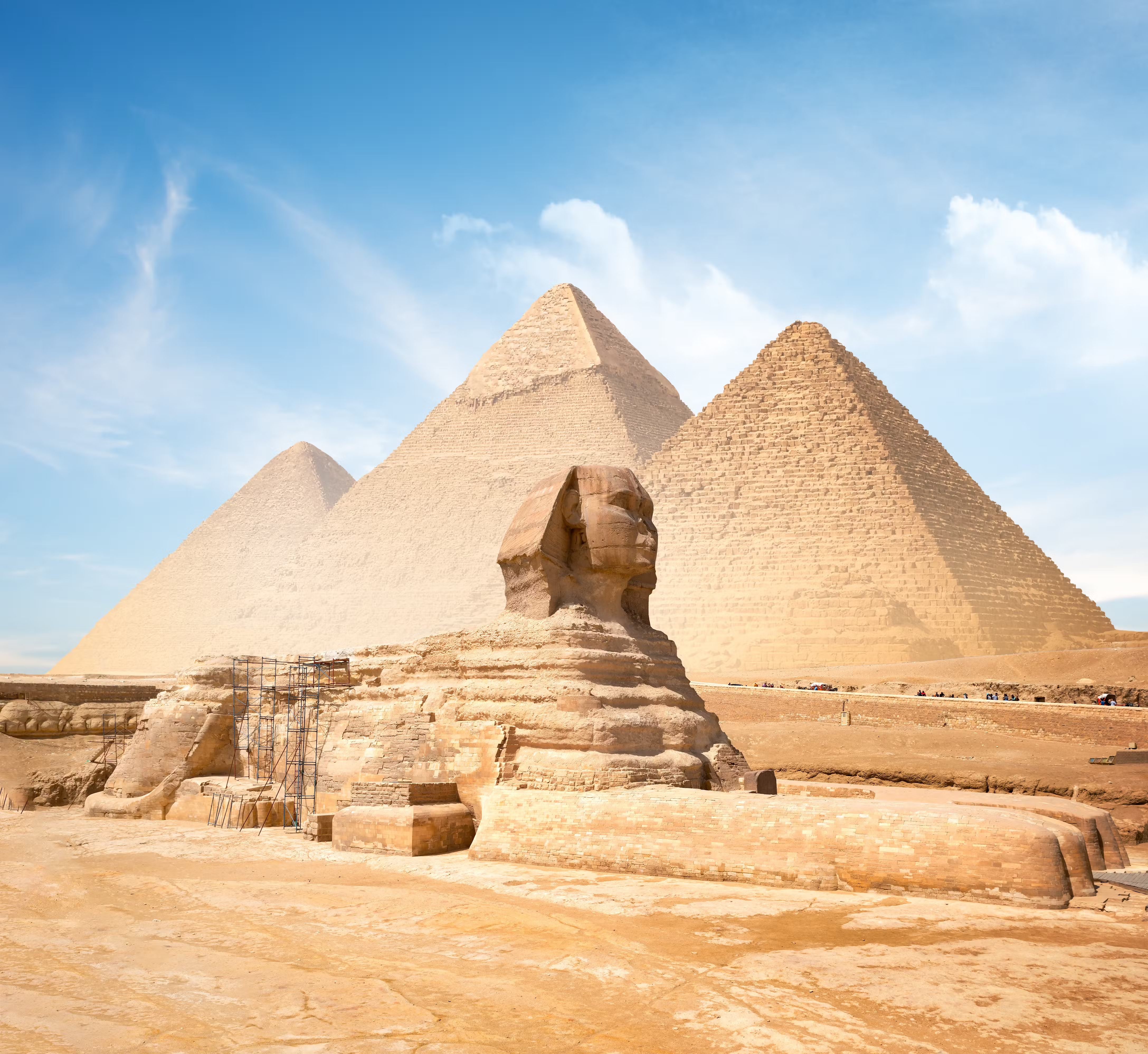
Pyramids of Giza egpyt, Egypt
"The largest pyramid in Egypt is the Great Pyramid of Giza. The pharaoh Khufu, who ruled during the Old Kingdom's Fourth Dynasty, was buried there. The pyramid is the oldest of the Seven Wonders of the Ancient World and the only one that has mostly survived. It was constructed in 2600 BC over a span of roughly 26 years. It is the most well-known structure inside the Giza pyramid complex, which is a part of the ""Memphis and its Necropolis"" UNESCO World Heritage Site. In relation to the three great pyramids of Giza, it is located near the northeastern end. For over 3,800 years, the Great Pyramid was the tallest man-made edifice in the world, standing at an initial height of 146.6 meters (481 feet). The pyramid's height was reduced to its current 138.5 meters (454.4 feet) when the smooth white limestone casing was mostly eroded over time; the underlying core structure is what is visible now. Including an interior hillock, the base's dimensions were around 230.3 meters (755.6 feet) square, resulting in a volume of about 2.6 million cubic meters (92 million cubic feet). An estimated 2.3 million massive blocks, totaling 6 million tonnes in weight, were quarried in order to build the Great Pyramid. Most of the stones are only loosely prepared and vary greatly in size and shape.Mortar was used to join the outer layers. It was built primarily of native limestone from the Giza Plateau. Additional blocks, including blocks of granite weighing up to 80 tons for the ""King's Chamber"" construction and white limestone from Tura for the casing, were brought in by boat on the Nile. The Great Pyramid is known to contain three rooms. The lowest, which was left incomplete, was carved into the bedrock that the pyramid was constructed on. Above ground, inside the pyramid structure, are the so-called Queen's Chamber and King's Chamber, which house a granite sarcophagus. His vizier, Hemiunu, is credited by some as the Great Pyramid's architect. The precise construction methods are the subject of numerous competing scientific and alternative theories, but as with most constructions of this type, there is no clear consensus. Five buried solar barques, two mortuary temples (one near the pyramid and one near the Nile) connected by a causeway, tombs for Khufu's immediate family and court, including three smaller pyramids for Khufu's wives, and an even smaller ""satellite pyramid"" made up the funerary complex surrounding the pyramid.
"In order to avoid crowds and the heat, it is advisable to visit the Pyramids of Giza in the colder months of November through February, preferably early in the morning or late in the afternoon. Peak season (November to February): With milder weather and easier access to the archaeological site, these are the ideal months to schedule a trip to the Giza Necropolis. You will have less time to explore the complex, though, as the Pyramids close early in the winter. March to May and September to October are considered mid-season. The temperature starts to warm up throughout these months. To enter the Necropolis before the sun rises, arrive early in the day. June to August is the low season. During these months, Egypt has exceptionally high temperatures, making outdoor activities intolerable. The best weather for sightseeing occurs around this time of year, which is frequently referred to as the high season. It is perfect for touring the pyramids without the harsh summer heat because of the pleasant temperatures, which range from 15°C to 25°C (59°F to 77°F). Most people agree that winter is the ideal season to visit Giza. This time of year offers pleasant moderate temperatures (15 to 20 degrees Celsius), which are perfect for touring the outdoor archaeological sites. The approximate cost per participant, including lodging but not meals, is between $2,160 to $4,900. The pharaohs, tombs, and temples of Egypt may entice tourists seeking a little mystery and wonder on their holiday, along with a dash of ancient history. Unless they are on a group tour with an approved travel agency, Indian nationals are not eligible to receive a visa upon arrival in Egypt. In these situations, the travel firm will verify the passport and remain at the airport when the client arrives. "The prices for Indian nationals seeking an Egypt visa are listed below. Three-month single-entry tourist visaService fees: Rs. 885; Visa fee: Rs. 2100 Single entry, three-month business visa fee of Rs. 4,800; service fees of Rs. 885" Ta'meya (falafel) and fuul (fava beans), served with pita bread and tahini sauce, are the mainstays of Egyptian cooking. Other well-liked foods are kofta (meatballs), molokhia (stewed greens), and koshari (rice, macaroni, and lentils). "You can take a guided pyramid tour, Uber, a cab, or a public bus from Cairo to the pyramids. Even while Uber, taxis, and public buses could be less expensive, taking a tour guarantees a more convenient and educational experience.The following are the top tour bus choices for getting to the Giza Pyramids: Tour bus from Cairo to the Pyramids of Giza Tour bus from Makadi Bay to the Pyramids of Giza Bus tour from Hurghada to the Pyramids of Giza By Metro Metro Line: M2; Nearest Stop: El Giza, Omm El-Misryeen (Giza station) Line M2 connects you to the nearest metro station, El Giza Omm El-Misryeen. To go to the Giza pyramids, you have to take a bus or a taxi from the metro station. The metro ride costs EGP 2 ($0.06) and takes around 20 minutes. By Taxi There are three kind of taxis in Egypt: yellow, white, and black. White taxis include air conditioning and a fare meter, while Black taxis are open to haggling and lack these amenities. The most costly choice are the yellow taxis, which require reservations. Additionally, you can reserve cabs for half-day or full-day journeys on Careem or Uber. From Cairo, a taxi travel takes about 30 minutes and costs between EGP 30 ($0.9) and EGP 50 ($1.62). By Automobile The fastest method to reach the Giza Pyramids is by automobile. Drive west on EL Tahrir if you're coming from center Cario. Continue on Charles de Gaulle via Gezira Island and head for Al Haram. Drive on to Tersa Street and Khatem El-Morsaleen from there. To go to the Pyramids of Giza, turn left onto Haret Eixis. "
 (1).jpg)
 (1).jpg)
.jpg)
.jpg)
 (1).jpg)
 (1).jpg)
.jpg)
.jpg)

.jpg)






