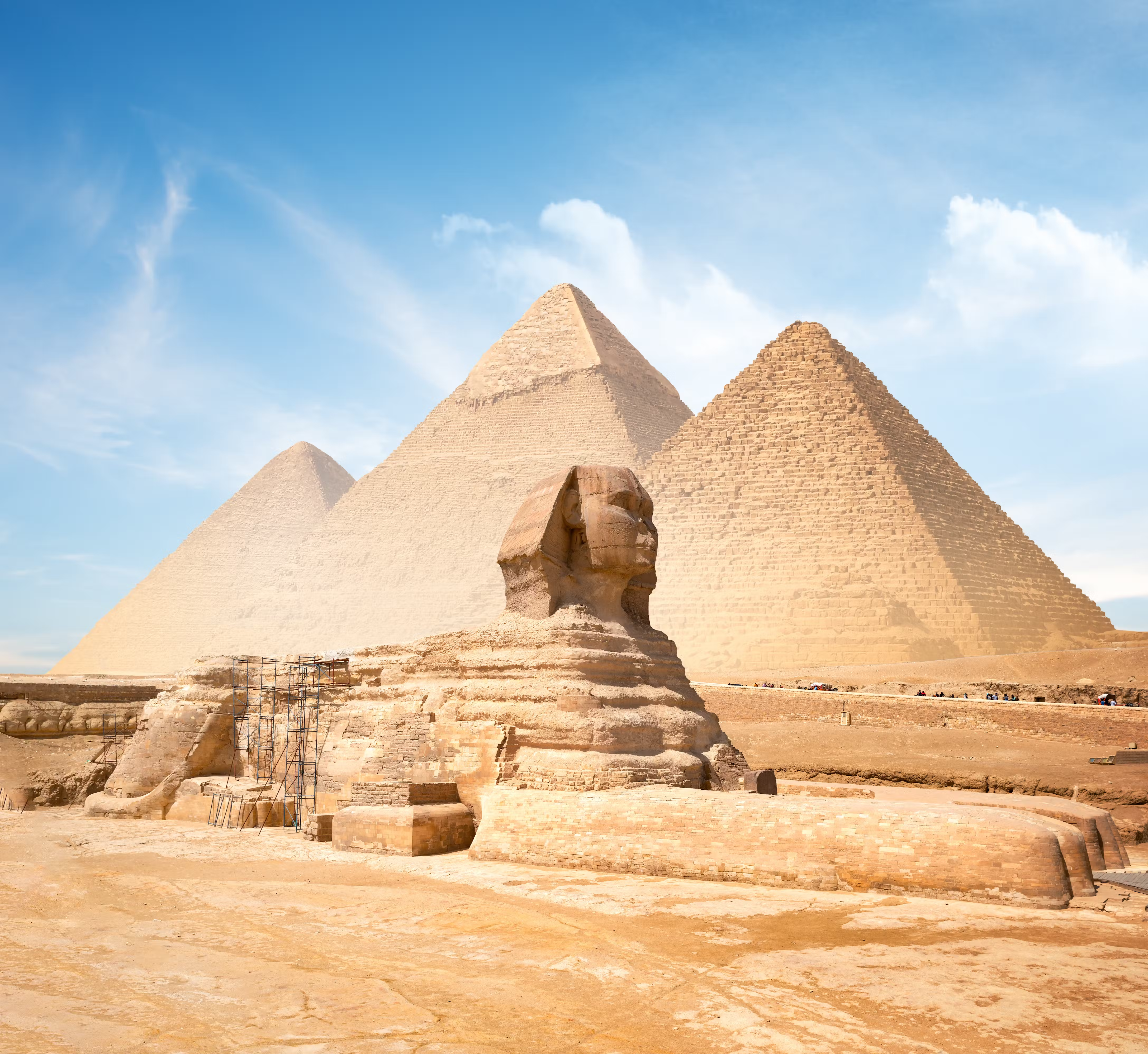
Pyramids of Giza egpyt
Pyramids of Giza egpyt
Egypt
EUROPE
Yes
20
"The largest pyramid in Egypt is the Great Pyramid of Giza. The pharaoh Khufu, who ruled during the Old Kingdom's Fourth Dynasty, was buried there. The pyramid is the oldest of the Seven Wonders of the Ancient World and the only one that has mostly survived. It was constructed in 2600 BC over a span of roughly 26 years. It is the most well-known structure inside the Giza pyramid complex, which is a part of the ""Memphis and its Necropolis"" UNESCO World Heritage Site. In relation to the three great pyramids of Giza, it is located near the northeastern end. For over 3,800 years, the Great Pyramid was the tallest man-made edifice in the world, standing at an initial height of 146.6 meters (481 feet). The pyramid's height was reduced to its current 138.5 meters (454.4 feet) when the smooth white limestone casing was mostly eroded over time; the underlying core structure is what is visible now. Including an interior hillock, the base's dimensions were around 230.3 meters (755.6 feet) square, resulting in a volume of about 2.6 million cubic meters (92 million cubic feet). An estimated 2.3 million massive blocks, totaling 6 million tonnes in weight, were quarried in order to build the Great Pyramid. Most of the stones are only loosely prepared and vary greatly in size and shape.Mortar was used to join the outer layers. It was built primarily of native limestone from the Giza Plateau. Additional blocks, including blocks of granite weighing up to 80 tons for the ""King's Chamber"" construction and white limestone from Tura for the casing, were brought in by boat on the Nile. The Great Pyramid is known to contain three rooms. The lowest, which was left incomplete, was carved into the bedrock that the pyramid was constructed on. Above ground, inside the pyramid structure, are the so-called Queen's Chamber and King's Chamber, which house a granite sarcophagus. His vizier, Hemiunu, is credited by some as the Great Pyramid's architect. The precise construction methods are the subject of numerous competing scientific and alternative theories, but as with most constructions of this type, there is no clear consensus. Five buried solar barques, two mortuary temples (one near the pyramid and one near the Nile) connected by a causeway, tombs for Khufu's immediate family and court, including three smaller pyramids for Khufu's wives, and an even smaller ""satellite pyramid"" made up the funerary complex surrounding the pyramid.
Cairo Africa
Cairo Africa
Cairo
AFRICAN
Yes
38
Cairo isn’t just the capital of Egypt — it’s the pulse of the nation. A city where ancient history meets modern chaos, where the call to prayer rises above the traffic, and where every alley seems to hum with life. Home to over 10 million people, Cairo is one of the biggest and most energetic cities in the Middle East and Africa. It’s a place of contrasts — the timeless Pyramids of Giza just a short drive from bustling markets, rooftop cafés, and shiny new malls. The Greater Cairo Metropolitan Area, with more than 22 million residents, is among the most populated urban regions on Earth. Surrounded by ancient sites like Memphis, Heliopolis, and the Giza Plateau, Cairo is a living bridge between Egypt’s past and its future. The city’s origins trace back to Fustat, Egypt’s first Islamic capital founded in 641 CE, and later to 969 CE, when the Fatimid dynasty created what we now call Cairo. Through centuries — under the Ayyubids, Mamluks, and beyond — the city became Egypt’s heart of architecture, art, and learning.
.jpg)

 (1).jpg)

.jpg)




.jpg)