The Grand Canyon USA
The Grand Canyon USA
USA
USA
Yes
25
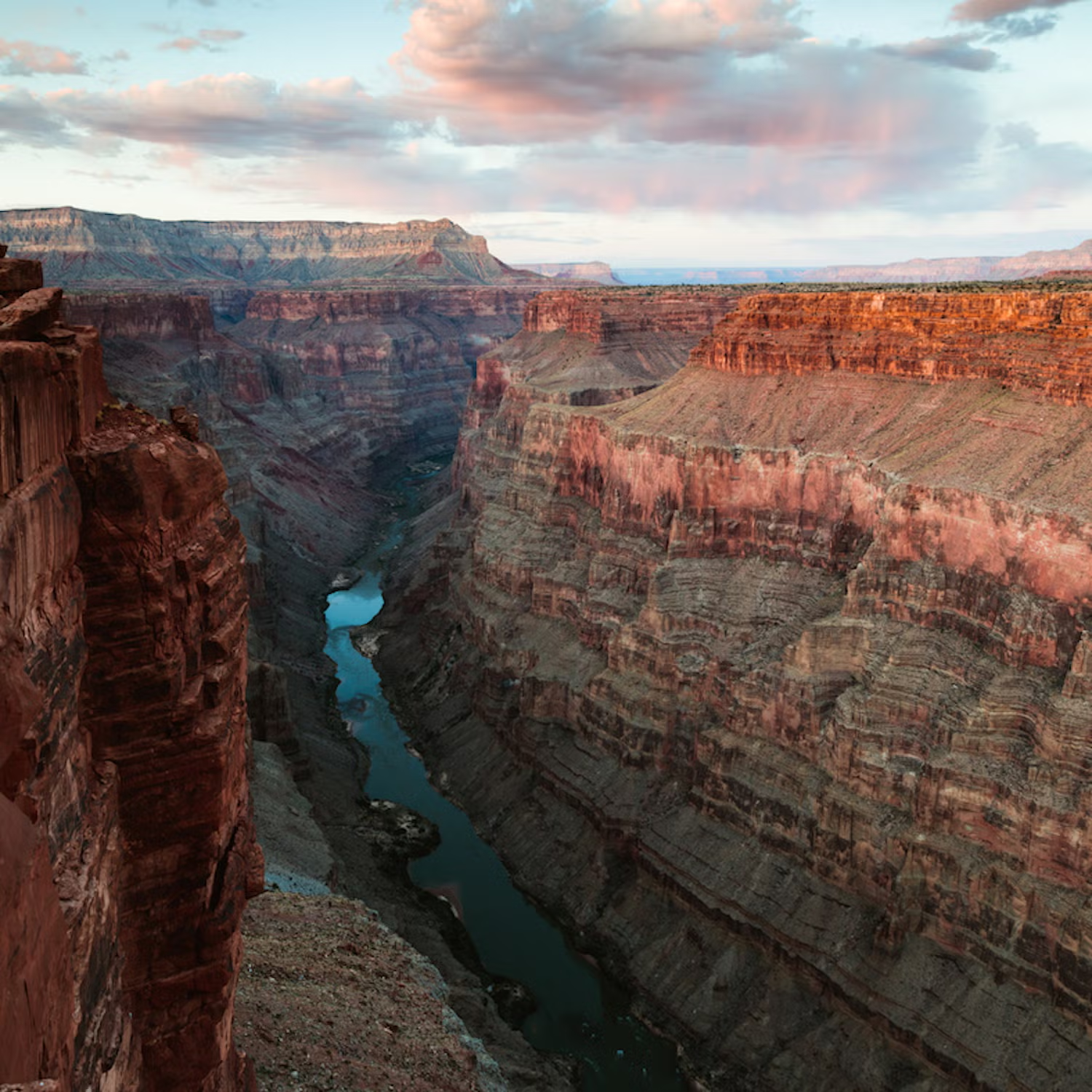
"The Colorado River sculpted the Grand Canyon, a steep-sided canyon in Arizona, USA. The Grand Canyon reaches a depth of more than a mile (6,093 feet or 1,857 meters) and is 277 miles (446 km) long and up to 18 miles (29 km) wide. Grand Canyon National Park, Kaibab National Forest, Grand Canyon–Parashant National Monument, the Hualapai Indian Reservation, the Havasupai Indian Reservation, and the Navajo Nation all contain the canyon and its surrounding rim. President Theodore Roosevelt frequently traveled to the Grand Canyon region to hunt and take in the landscape, and he was a strong advocate for its preservation. Native Americans have lived in the region continuously for thousands of years, establishing settlements inside the canyon and its numerous caverns. The Grand Canyon was a sacred place to the Pueblo people, who visited it on pilgrimage.Arriving from Spain in 1540, García López de Cárdenas is the first European recorded to have seen the Grand Canyon. One of the six separate physiographic regions of the Colorado Plateau province, the Grand Canyon is a river valley in the Colorado Plateau that reveals uplifted Proterozoic and Paleozoic strata.The Grand Canyon is renowned for its breathtaking vastness and its complex and vibrant terrain, while not being the deepest canyon on land in the world (the Kali Gandaki Gorge in Nepal is far deeper). The thick sequence of old rocks that are exposed and well-preserved in the canyon walls makes it noteworthy geologically. Much of the early geologic history of the continent of North America is preserved in these rock layers. The Colorado River basin, which includes the Grand Canyon, formed during the last 70 million years.The geologic origins of the Grand Canyon and the Colorado River have been the subject of data collection, innovative ideas, and often controversial theories by scientists for more than 150 years. A complicated history involving the interaction of numerous geologic events and variables throughout time and in various locations may have contributed to the formation of the Grand Canyon and the Colorado River. The modern-day Four Corners region of the United States was the heart of the Native American society known as the Ancestral Puebloans. They were the earliest known inhabitants of the region surrounding the Grand Canyon. Although the contemporary Puebloan peoples do not favor the term, the cultural group has frequently been referred to as the Anasazi in archaeology.""Anasazi"" means ""enemy ancestors"" or ""alien ancestors"" in Navajo.
Maasai Mara Africa
Maasai Mara Africa
Africa
AFRICAN
Yes
38
Maasai Mara, frequently spelled Masai Mara, and referred to locals as just "The Mara," is a sizable national game reserve in Kenya's Narok County that borders Tanzania's Serengeti National Park. The Maasai people, the region's original occupants who came from the Nile Basin, are honored by the name. From a distance, their description of the region is as follows: "Mara" means "spotted" in the Maa language due to the short, bushy trees that are scattered throughout the terrain. With its populations of lions, leopards, cheetahs, and African bush elephants, the Maasai Mara is one of Africa's wilderness and wildlife protection areas. In addition, it is home to the Great Migration, which has earned it a spot among the ten Wonders of the World and the Seven Natural Wonders of Africa. Depending on the weather, the Great Migration often takes place in July when a huge number of wildebeest migrate from Tanzania across the Mara River. The Maasai Mara National Reserve, the Mara Triangle, a number of Maasai group ranches, and Maasai Mara conservancies are all included in the Greater Mara ecosystem. The Masai Mara, sometimes referred to as "the world's eight world wonders" or one of the most well-known wildlife places in the world, is home to an abundance of species, breathtaking views, and unending plains.The Masai Mara National Reserve, an unfenced reserve with unrestricted wildlife movement, and a number of conservancies comprise the Greater Masai Mara area. Maasai families privately own these parcels of land. The Maasai families who lease their property to safari lodges have the opportunity to use the money they make from the conservancies to fund development or education projects in their communities. The Masai Mara was called in honour of the Maasai people, the traditional residents of the area. 'Mara' means'spotted' in Maasai (Maa) dialect. It won't be difficult to comprehend how the Masai Mara gained its name after visiting. The terrain does appear somewhat'spotted' due to the small, bushy trees that dot it. The environment of the Greater Masai Mara is enormous. It is almost 1510 square kilometers in size. The Serengeti National Park in Tanzania is adjacent to the Maasai Mara, a sizable game reserve in Narok County, Kenya. It is named after the Maasai people, who were the original occupants of the region, and how they described it from a distance: "Mara" means "spotted" in the Maasai language, referring to the numerous trees, plants, cloud shadows, and animals that dotted the terrain.


 (1).jpg)

.jpg)

.jpg)


.jpg)