The Grand Canyon USA
The Grand Canyon USA
USA
USA
Yes
25
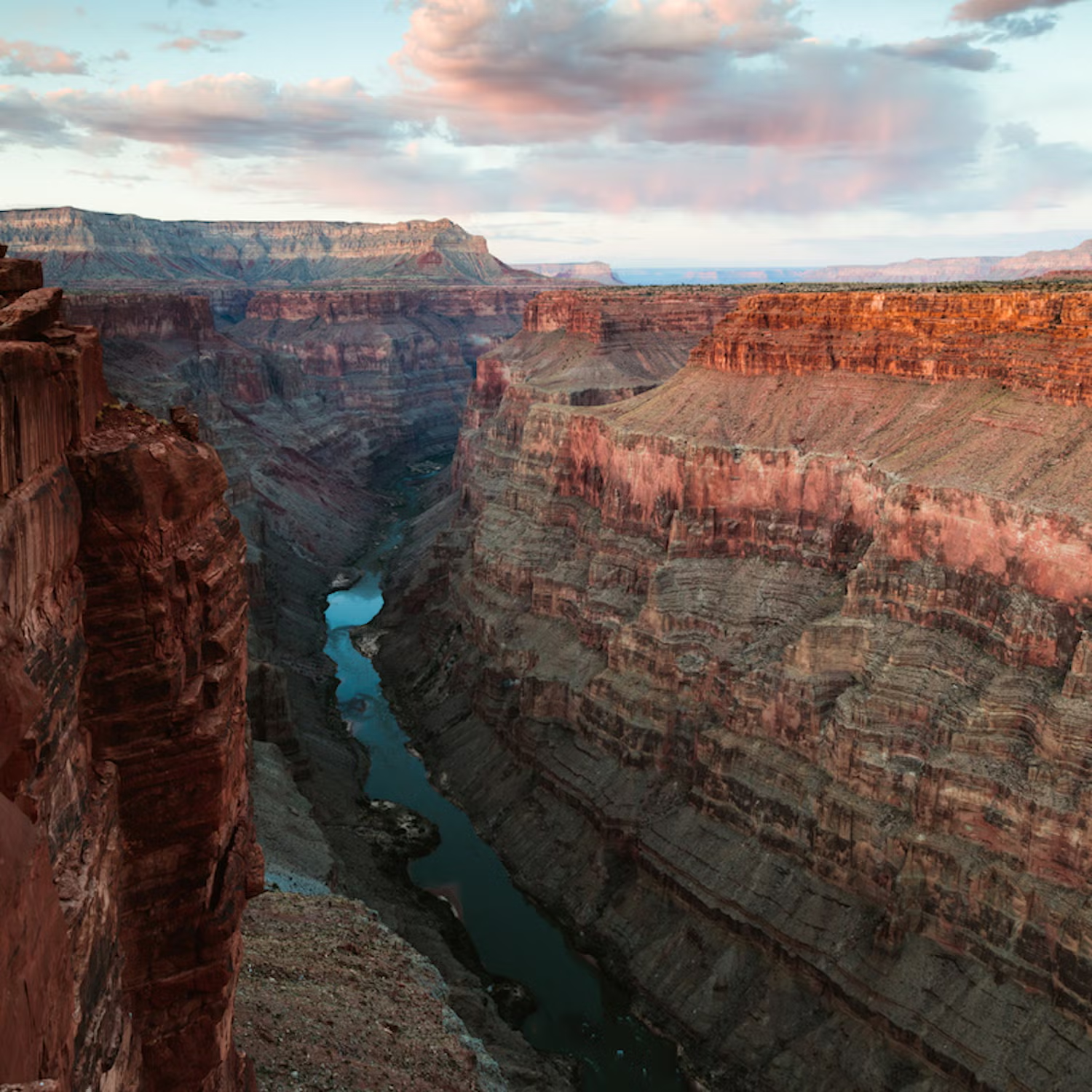
"The Colorado River sculpted the Grand Canyon, a steep-sided canyon in Arizona, USA. The Grand Canyon reaches a depth of more than a mile (6,093 feet or 1,857 meters) and is 277 miles (446 km) long and up to 18 miles (29 km) wide. Grand Canyon National Park, Kaibab National Forest, Grand Canyon–Parashant National Monument, the Hualapai Indian Reservation, the Havasupai Indian Reservation, and the Navajo Nation all contain the canyon and its surrounding rim. President Theodore Roosevelt frequently traveled to the Grand Canyon region to hunt and take in the landscape, and he was a strong advocate for its preservation. Native Americans have lived in the region continuously for thousands of years, establishing settlements inside the canyon and its numerous caverns. The Grand Canyon was a sacred place to the Pueblo people, who visited it on pilgrimage.Arriving from Spain in 1540, García López de Cárdenas is the first European recorded to have seen the Grand Canyon. One of the six separate physiographic regions of the Colorado Plateau province, the Grand Canyon is a river valley in the Colorado Plateau that reveals uplifted Proterozoic and Paleozoic strata.The Grand Canyon is renowned for its breathtaking vastness and its complex and vibrant terrain, while not being the deepest canyon on land in the world (the Kali Gandaki Gorge in Nepal is far deeper). The thick sequence of old rocks that are exposed and well-preserved in the canyon walls makes it noteworthy geologically. Much of the early geologic history of the continent of North America is preserved in these rock layers. The Colorado River basin, which includes the Grand Canyon, formed during the last 70 million years.The geologic origins of the Grand Canyon and the Colorado River have been the subject of data collection, innovative ideas, and often controversial theories by scientists for more than 150 years. A complicated history involving the interaction of numerous geologic events and variables throughout time and in various locations may have contributed to the formation of the Grand Canyon and the Colorado River. The modern-day Four Corners region of the United States was the heart of the Native American society known as the Ancestral Puebloans. They were the earliest known inhabitants of the region surrounding the Grand Canyon. Although the contemporary Puebloan peoples do not favor the term, the cultural group has frequently been referred to as the Anasazi in archaeology.""Anasazi"" means ""enemy ancestors"" or ""alien ancestors"" in Navajo.
Cape Town
Cape Town
South Africa
AFRICAN
Yes
35
South Africa's legislative capital is Cape Town. It is the oldest city in the nation and the location of the South African Parliament. Cape Town is the largest city in the Western Cape and the second most populous city in the nation, after Johannesburg.The city is a part of the metropolitan municipality known as the City of Cape Town.Table Mountain, Cape Point, the city's harbor, and its natural environment in the Cape Floristic Region are some of its most well-known features. Numerous publications have ranked Cape Town as the world's greatest city and the finest place to go, including Time Out in 2025, The New York Times in 2014, and The Telegraph for the last eight years (2017–2025). With the greatest concentration of Cape Dutch-style buildings worldwide, Cape Town is renowned for its architectural legacy. Constantia, the historic government buildings in the Central Business District, and Long Street are the best examples of the Cape Dutch architectural style, which blends the architectural traditions of the Netherlands, Germany, France, and Indonesia. Mostert's Mill in Mowbray is the only fully operational windmill in South Africa. Constructed in 1796, it underwent restorations in 1935 and 1995. In 2014, the International Council of Societies of Industrial Design declared Cape Town the World Design Capital. Additionally, Cape Town is designated a "Design City" by the Creative Cities Network of UNESCO. Cape Town's biggest performing arts facility is the Artscape Theatre Centre. The 17th-century savory, sweet, spiced beef dish known as bobotie is one of the foods that originated in Cape Town or is associated with it. A sandwich stuffed with slap chips and other toppings, the Gatsby was initially offered in the Athlone area in 1976 and has since come to represent the city.A classic Cape Malay dessert, the koe'sister is characterized as a cake-like dumpling flavored with cinnamon and topped with a dusting of desiccated coconut. Table Mountain's mass and the chilly Benguela Current of the South Atlantic Ocean both locally alter Cape Town's Mediterranean climate. While the average high temperature is 70°F (21°C) in January and February and the average low temperature is 55°F (13°C) in July, the coast and mountain slopes experience colder weather. Freezing rarely happens. Rainfall occurs on 69 days of the year on average; the southern winter months of June through August account for roughly half of the 26 inches (660 millimeters) of yearly rainfall. Every year, almost five million tons of goods pass through the port of Cape Town. Although ships with a draft of more than 40 feet are not permitted to enter the port during low tide, interoceanic commerce benefits greatly from its dry dock and maintenance facilities. Container traffic is accommodated at the Ben Schoeman Dock.


 (1).jpg)

.jpg)

.jpg)


.jpg)