The Grand Canyon USA
The Grand Canyon USA
USA
USA
Yes
25
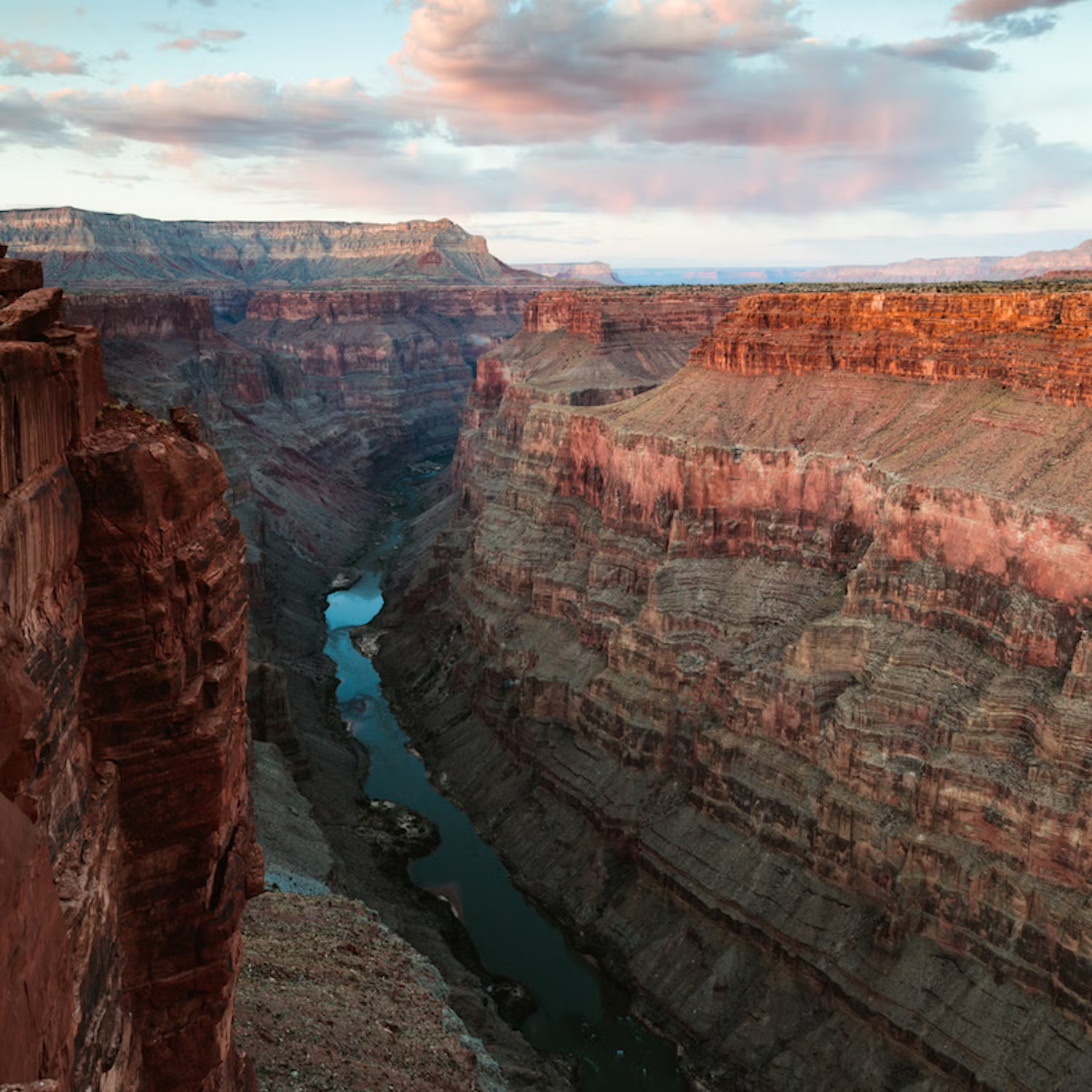
"The Colorado River sculpted the Grand Canyon, a steep-sided canyon in Arizona, USA. The Grand Canyon reaches a depth of more than a mile (6,093 feet or 1,857 meters) and is 277 miles (446 km) long and up to 18 miles (29 km) wide. Grand Canyon National Park, Kaibab National Forest, Grand Canyon–Parashant National Monument, the Hualapai Indian Reservation, the Havasupai Indian Reservation, and the Navajo Nation all contain the canyon and its surrounding rim. President Theodore Roosevelt frequently traveled to the Grand Canyon region to hunt and take in the landscape, and he was a strong advocate for its preservation. Native Americans have lived in the region continuously for thousands of years, establishing settlements inside the canyon and its numerous caverns. The Grand Canyon was a sacred place to the Pueblo people, who visited it on pilgrimage.Arriving from Spain in 1540, García López de Cárdenas is the first European recorded to have seen the Grand Canyon. One of the six separate physiographic regions of the Colorado Plateau province, the Grand Canyon is a river valley in the Colorado Plateau that reveals uplifted Proterozoic and Paleozoic strata.The Grand Canyon is renowned for its breathtaking vastness and its complex and vibrant terrain, while not being the deepest canyon on land in the world (the Kali Gandaki Gorge in Nepal is far deeper). The thick sequence of old rocks that are exposed and well-preserved in the canyon walls makes it noteworthy geologically. Much of the early geologic history of the continent of North America is preserved in these rock layers. The Colorado River basin, which includes the Grand Canyon, formed during the last 70 million years.The geologic origins of the Grand Canyon and the Colorado River have been the subject of data collection, innovative ideas, and often controversial theories by scientists for more than 150 years. A complicated history involving the interaction of numerous geologic events and variables throughout time and in various locations may have contributed to the formation of the Grand Canyon and the Colorado River. The modern-day Four Corners region of the United States was the heart of the Native American society known as the Ancestral Puebloans. They were the earliest known inhabitants of the region surrounding the Grand Canyon. Although the contemporary Puebloan peoples do not favor the term, the cultural group has frequently been referred to as the Anasazi in archaeology.""Anasazi"" means ""enemy ancestors"" or ""alien ancestors"" in Navajo.
Cairo Africa
Cairo Africa
Cairo
AFRICAN
Yes
38
Cairo isn’t just the capital of Egypt — it’s the pulse of the nation. A city where ancient history meets modern chaos, where the call to prayer rises above the traffic, and where every alley seems to hum with life. Home to over 10 million people, Cairo is one of the biggest and most energetic cities in the Middle East and Africa. It’s a place of contrasts — the timeless Pyramids of Giza just a short drive from bustling markets, rooftop cafés, and shiny new malls. The Greater Cairo Metropolitan Area, with more than 22 million residents, is among the most populated urban regions on Earth. Surrounded by ancient sites like Memphis, Heliopolis, and the Giza Plateau, Cairo is a living bridge between Egypt’s past and its future. The city’s origins trace back to Fustat, Egypt’s first Islamic capital founded in 641 CE, and later to 969 CE, when the Fatimid dynasty created what we now call Cairo. Through centuries — under the Ayyubids, Mamluks, and beyond — the city became Egypt’s heart of architecture, art, and learning.
.jpg)

 (1).jpg)

.jpg)




.jpg)