Hawaii
Hawaii
North America
NORTH AMERICA
Yes
19
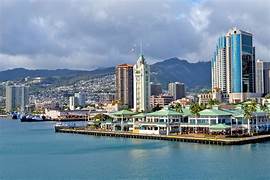
"Located in the Pacific Ocean approximately 2,000 miles (3,200 km) southwest of the U.S. mainland lies the U.S. island state of Hawaii. It is the only state not on the North American mainland, the only state that is an archipelago, the only state in the tropics, and one of the two non-contiguous U.S. states (along with Alaska). Nearly the whole Hawaiian archipelago is made up of 137 volcanic islands, with Midway Atoll being the only one that is not part of the state. The state, which spans 1,500 miles (2,400 km), is a part of Oceania's Polynesian subregion both physiographically and ethnologically. At roughly 750 miles (1,210 km), Hawaii's ocean coastline is therefore the fourth longest in the United States. From northwest to southeast, the state is named after the eight major islands: Niʻihau, Kauaʻi, Oʻahu, Molokaʻi, Lānaʻi, Kahoʻolawe, Maui, and Hawaiʻi. The latter is frequently referred to as the ""Big Island"" or ""Hawaiʻi Island"" to distinguish it from the state or archipelago. The largest protected area in the United States and the fourth largest in the world, Papahānaumokuākea Marine National Monument, is primarily comprised of the uninhabited Northwestern Hawaiian Islands. Hawaii, which has historically been a plantation state, is still a significant exporter of agricultural products because of its rich soil and unusually tropical environment. Since the middle of the 20th century, its economy has steadily diversified, with the two biggest industries now being tourism and military defense. The state's varied natural landscape, warm tropical climate, large number of public beaches, maritime environs, active volcanoes, and beautiful skies on the Big Island all draw tourists, surfers, and scientists. The name of Hawaii's largest island, Hawaiʻi, is the source of the state's name. Hawaiʻi's name is frequently explained as having been given in honor of Hawaiʻiloa, a figure from Hawaiian oral history. When the islands were first inhabited, he is credited with discovering them. Hawaiian was included as an official state language alongside English in the State of Hawaii's 1978 Constitution.The Constitution of the State of Hawaii is the name of the state constitution. The State of Hawaii is used in Article XV, Section 1 of the Constitution. Since the 1949 draft of the paper predates the usage of the ʻokina ⟨ʻ⟩ and the kahakō in contemporary Hawaiian spelling, diacritical marks were not utilized. The state's name is spelled Hawaiʻi in the Hawaiian language.The federal government chose Hawaii as the state name in the Hawaii Admission Act, which made Hawaii a state. The climate of Hawaiʻi is tropical. Due to almost continual easterly trade breezes, temperatures and humidity are generally less extreme. Summer temperatures range from lows of 75 °F (24 °C) at night to highs of about 88 °F (31 °C) during the day. At low elevation, winter temperatures rarely fall below 65 °F (18 °C) at night; instead, they often hover around 83 °F (28 °C) throughout the day. Not typically found in tropical regions, snow falls at 13,800 feet (4,200 meters) on Hawaii Island's Mauna Kea and Mauna Loa during certain winter months. Texas and Hawaiʻi are the only two U.S. states that were once sovereign nations recognized by other countries before joining the union. From 1810 until its overthrow in 1893 by American and European landowners and businessmen, the Kingdom of Hawaiʻi ruled as a sovereign state. From 1894 until August 12, 1898, when it was formally recognized as a U.S. territory, Hawaiʻi was a separate republic. August 21, 1959, marked Hawaiʻi's admission as a U.S. state. "
Cape Town
Cape Town
South Africa
AFRICAN
Yes
35
South Africa's legislative capital is Cape Town. It is the oldest city in the nation and the location of the South African Parliament. Cape Town is the largest city in the Western Cape and the second most populous city in the nation, after Johannesburg.The city is a part of the metropolitan municipality known as the City of Cape Town.Table Mountain, Cape Point, the city's harbor, and its natural environment in the Cape Floristic Region are some of its most well-known features. Numerous publications have ranked Cape Town as the world's greatest city and the finest place to go, including Time Out in 2025, The New York Times in 2014, and The Telegraph for the last eight years (2017–2025). With the greatest concentration of Cape Dutch-style buildings worldwide, Cape Town is renowned for its architectural legacy. Constantia, the historic government buildings in the Central Business District, and Long Street are the best examples of the Cape Dutch architectural style, which blends the architectural traditions of the Netherlands, Germany, France, and Indonesia. Mostert's Mill in Mowbray is the only fully operational windmill in South Africa. Constructed in 1796, it underwent restorations in 1935 and 1995. In 2014, the International Council of Societies of Industrial Design declared Cape Town the World Design Capital. Additionally, Cape Town is designated a "Design City" by the Creative Cities Network of UNESCO. Cape Town's biggest performing arts facility is the Artscape Theatre Centre. The 17th-century savory, sweet, spiced beef dish known as bobotie is one of the foods that originated in Cape Town or is associated with it. A sandwich stuffed with slap chips and other toppings, the Gatsby was initially offered in the Athlone area in 1976 and has since come to represent the city.A classic Cape Malay dessert, the koe'sister is characterized as a cake-like dumpling flavored with cinnamon and topped with a dusting of desiccated coconut. Table Mountain's mass and the chilly Benguela Current of the South Atlantic Ocean both locally alter Cape Town's Mediterranean climate. While the average high temperature is 70°F (21°C) in January and February and the average low temperature is 55°F (13°C) in July, the coast and mountain slopes experience colder weather. Freezing rarely happens. Rainfall occurs on 69 days of the year on average; the southern winter months of June through August account for roughly half of the 26 inches (660 millimeters) of yearly rainfall. Every year, almost five million tons of goods pass through the port of Cape Town. Although ships with a draft of more than 40 feet are not permitted to enter the port during low tide, interoceanic commerce benefits greatly from its dry dock and maintenance facilities. Container traffic is accommodated at the Ben Schoeman Dock.


 (1).jpg)

.jpg)

.jpg)


.jpg)