Hawaii
Hawaii
North America
NORTH AMERICA
Yes
19
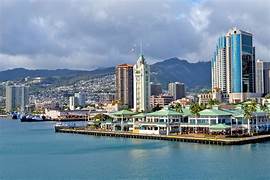
"Located in the Pacific Ocean approximately 2,000 miles (3,200 km) southwest of the U.S. mainland lies the U.S. island state of Hawaii. It is the only state not on the North American mainland, the only state that is an archipelago, the only state in the tropics, and one of the two non-contiguous U.S. states (along with Alaska). Nearly the whole Hawaiian archipelago is made up of 137 volcanic islands, with Midway Atoll being the only one that is not part of the state. The state, which spans 1,500 miles (2,400 km), is a part of Oceania's Polynesian subregion both physiographically and ethnologically. At roughly 750 miles (1,210 km), Hawaii's ocean coastline is therefore the fourth longest in the United States. From northwest to southeast, the state is named after the eight major islands: Niʻihau, Kauaʻi, Oʻahu, Molokaʻi, Lānaʻi, Kahoʻolawe, Maui, and Hawaiʻi. The latter is frequently referred to as the ""Big Island"" or ""Hawaiʻi Island"" to distinguish it from the state or archipelago. The largest protected area in the United States and the fourth largest in the world, Papahānaumokuākea Marine National Monument, is primarily comprised of the uninhabited Northwestern Hawaiian Islands. Hawaii, which has historically been a plantation state, is still a significant exporter of agricultural products because of its rich soil and unusually tropical environment. Since the middle of the 20th century, its economy has steadily diversified, with the two biggest industries now being tourism and military defense. The state's varied natural landscape, warm tropical climate, large number of public beaches, maritime environs, active volcanoes, and beautiful skies on the Big Island all draw tourists, surfers, and scientists. The name of Hawaii's largest island, Hawaiʻi, is the source of the state's name. Hawaiʻi's name is frequently explained as having been given in honor of Hawaiʻiloa, a figure from Hawaiian oral history. When the islands were first inhabited, he is credited with discovering them. Hawaiian was included as an official state language alongside English in the State of Hawaii's 1978 Constitution.The Constitution of the State of Hawaii is the name of the state constitution. The State of Hawaii is used in Article XV, Section 1 of the Constitution. Since the 1949 draft of the paper predates the usage of the ʻokina ⟨ʻ⟩ and the kahakō in contemporary Hawaiian spelling, diacritical marks were not utilized. The state's name is spelled Hawaiʻi in the Hawaiian language.The federal government chose Hawaii as the state name in the Hawaii Admission Act, which made Hawaii a state. The climate of Hawaiʻi is tropical. Due to almost continual easterly trade breezes, temperatures and humidity are generally less extreme. Summer temperatures range from lows of 75 °F (24 °C) at night to highs of about 88 °F (31 °C) during the day. At low elevation, winter temperatures rarely fall below 65 °F (18 °C) at night; instead, they often hover around 83 °F (28 °C) throughout the day. Not typically found in tropical regions, snow falls at 13,800 feet (4,200 meters) on Hawaii Island's Mauna Kea and Mauna Loa during certain winter months. Texas and Hawaiʻi are the only two U.S. states that were once sovereign nations recognized by other countries before joining the union. From 1810 until its overthrow in 1893 by American and European landowners and businessmen, the Kingdom of Hawaiʻi ruled as a sovereign state. From 1894 until August 12, 1898, when it was formally recognized as a U.S. territory, Hawaiʻi was a separate republic. August 21, 1959, marked Hawaiʻi's admission as a U.S. state. "
Kruger National Park Africa
Kruger National Park Africa
Africa
AFRICAN
Yes
37
Covering 19,623 km2 (7,576 sq mi), Kruger National Park is located in the northeastern South African provinces of Mpumalanga and Limpopo. It stretches 65 km (40 mi) from east to west and 360 km (220 mi) from north to south. Skukuza is home to the administrative headquarters. The South African Republic's government first protected portions of the park in 1898, and in 1926 it was designated as the country's first national park. It is a part of the biosphere reserve known as the Kruger to Canyons Biosphere. Kruger National Park is home to all five of the big game creatures and boasts 147 species of large mammals, more than any other game reserve in Africa. Webcams have been installed to watch the wildlife. There are believed to be just 400 African wild dog packs in all of South Africa, and Kruger is home to packs of these endangered animals. There is a reasonably consistent group of bird species from the park's southern to central regions, but the mopane-dominated flatlands north of the Olifants show a fall in richness.The larger birds of prey, on the other hand, breed during the dry winter, when their prey is most exposed, whereas the majority of species breed during the summer, when rainfall sustain the majority of vegetable and animal food. In 1918, Kruger National Park was declared, and a commission was formed to oversee its development and planning. A government officer named Johannes Andries (Dries) de Ridder served as the commission's first secretary. After 44 years in charge of the Kruger Park, Warden James Stevenson-Hamilton retired on April 30, 1946. Colonel J. A. B. Sandenbergh of the South African Air Force took his post. The government forcibly removed the Makuleke people from the northern portion of the park in 1969, and approximately 1500 of them were relocated to territory in the south so that their original tribal lands could be incorporated into the larger Kruger National Park. The famed Big Five (lion, leopard, elephant, rhinoceros, and buffalo) are among the remarkably diverse species that makes Kruger National Park famous. The park, which spans about two million hectares, draws tourists from all around the world with its unmatched wildlife viewing opportunities.


 (1).jpg)

.jpg)

.jpg)


.jpg)