Queenstown
Queenstown
Australia
AUSTRALIA
Yes
23
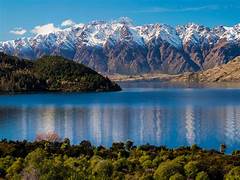
"In Otago, in the southwest of the South Island of New Zealand, sits the resort town of Queenstown. The Queenstown-Lakes District's largest town and seat is this one. With views of the surrounding mountains, including The Remarkables, Cecil Peak, Walter Peak, and Ben Lomond and Queenstown Hill, the town is situated on the northwest shore of Lake Wakatipu, a long, thin, Z-shaped lake created by glacial processes. Adventure and ski tourism are two of Queenstown's most well-known tourism-related industries. Queenstown has an oceanic climate (Köppen climatic classification Cfb) due to its high mountain environs and relatively modest elevation (310 meters).While winters are frigid, with temperatures frequently in the single digits and heavy snowfall, even if there is seldom any permanent snow cover, summers have long, balmy days with temperatures as high as 30 °C. Queenstown is located in the rain shadow of the Southern Alps, just like the rest of Central Otago. However, because it is closer to the west coast than Cromwell, Wānaka, and Alexandra, it is more vulnerable to rain-bearing fronts. There are numerous festivals in Queenstown.Winter Pride (August–September), the biggest winter pride celebration in the Southern Hemisphere, the Jazz Festival (October), the ten-day Bike Festival in January, and the Winter Festival in June are a few examples. Locations for movies and television Top of the Lake, Jane Campion's six-part drama mystery, was filmed in 2012 and aired on pay television in 2013. The Southern Alps are breathtaking, and the Wakatipu lakes seem menacing. Scenes were filmed in a grocery and bottle shop on Shotover Street, as well as on Lower Beach Street and Coronation Drive, with Moke Lake serving as the primary site. As of March 2025, there were 569 students enrolled in Queenstown Primary School, a coeducational state primary school serving children in Years 1 through 8. With 138 pupils enrolled, St. Joseph's School is a coeducational Catholic state-integrated primary school for kids in Years 1 through 8. Additionally, there are a school in Shotover Country and two elementary schools in Frankton. "
Kruger National Park Africa
Kruger National Park Africa
Africa
AFRICAN
Yes
37
Covering 19,623 km2 (7,576 sq mi), Kruger National Park is located in the northeastern South African provinces of Mpumalanga and Limpopo. It stretches 65 km (40 mi) from east to west and 360 km (220 mi) from north to south. Skukuza is home to the administrative headquarters. The South African Republic's government first protected portions of the park in 1898, and in 1926 it was designated as the country's first national park. It is a part of the biosphere reserve known as the Kruger to Canyons Biosphere. Kruger National Park is home to all five of the big game creatures and boasts 147 species of large mammals, more than any other game reserve in Africa. Webcams have been installed to watch the wildlife. There are believed to be just 400 African wild dog packs in all of South Africa, and Kruger is home to packs of these endangered animals. There is a reasonably consistent group of bird species from the park's southern to central regions, but the mopane-dominated flatlands north of the Olifants show a fall in richness.The larger birds of prey, on the other hand, breed during the dry winter, when their prey is most exposed, whereas the majority of species breed during the summer, when rainfall sustain the majority of vegetable and animal food. In 1918, Kruger National Park was declared, and a commission was formed to oversee its development and planning. A government officer named Johannes Andries (Dries) de Ridder served as the commission's first secretary. After 44 years in charge of the Kruger Park, Warden James Stevenson-Hamilton retired on April 30, 1946. Colonel J. A. B. Sandenbergh of the South African Air Force took his post. The government forcibly removed the Makuleke people from the northern portion of the park in 1969, and approximately 1500 of them were relocated to territory in the south so that their original tribal lands could be incorporated into the larger Kruger National Park. The famed Big Five (lion, leopard, elephant, rhinoceros, and buffalo) are among the remarkably diverse species that makes Kruger National Park famous. The park, which spans about two million hectares, draws tourists from all around the world with its unmatched wildlife viewing opportunities.


 (1).jpg)

.jpg)

.jpg)


.jpg)