Madrid Spain
Madrid Spain
Spain
EUROPE
Yes
25
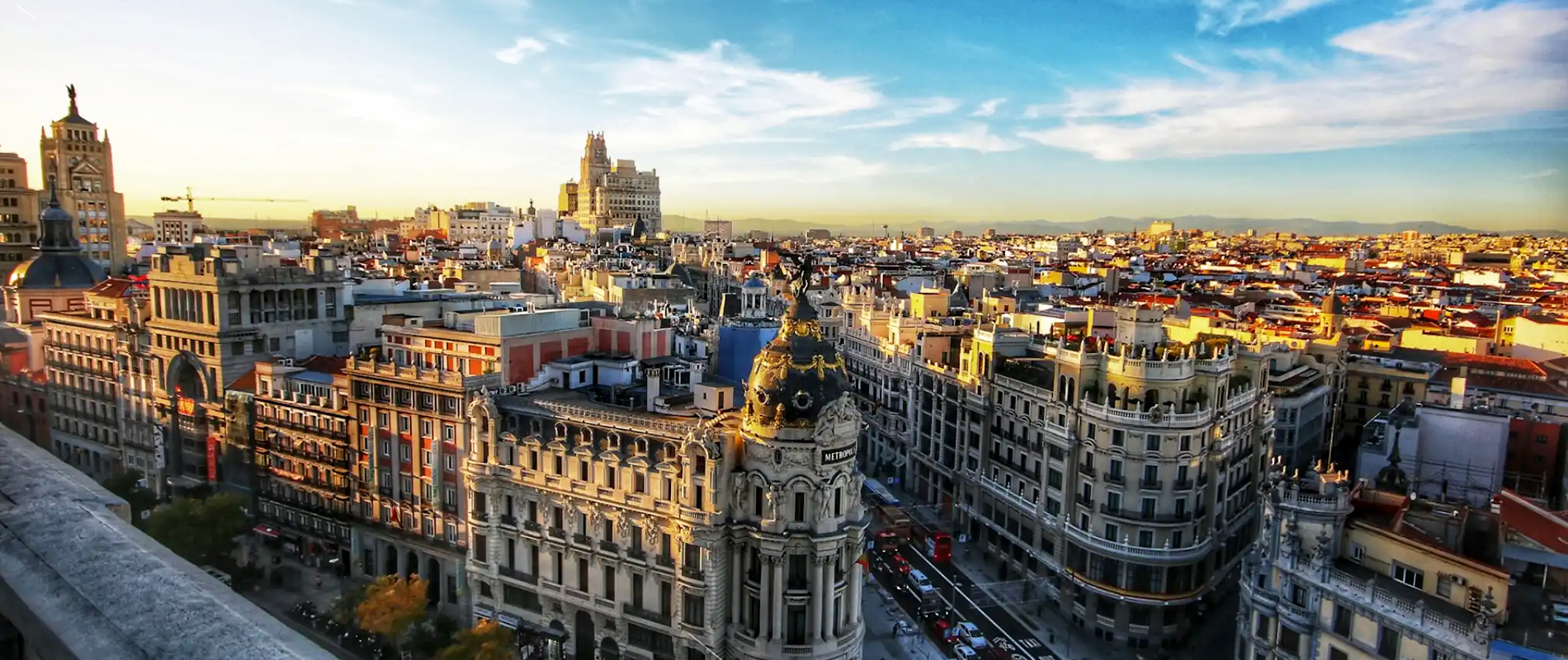
Spain's capital and most populated city is Madrid. There are about 3.5 million people living there, and there are about 7 million people living in the metropolitan region. Its metropolitan area is the second largest in the European Union (EU), and it is the second-largest city in the EU, behind Berlin, Germany.The municipality's total land area is 604.3 km² (233.3 sq mi).At roughly 650 meters (2,130 feet) above mean sea level, Madrid is located on the River Manzanares in the center of the Iberian Peninsula. As the capital of Spain and the nearby autonomous community of Madrid (since 1983), it serves as the nation's political, economic, and cultural hub. Under the Emirate of Córdoba, Madrid's rudimentary walled military outpost was established in the late ninth century. After being overrun by Christians in 1083 or 1085, it became a major town under the Crown of Castile in the Late Middle Ages. As the permanent location of the Hispanic Monarchy's court, Madrid's growth as an administrative hub was encouraged after 1561. The location of contemporary In addition to Roman villas, a Visigoth basilica close to the church of Santa María de la Almudena, three Visigoth necropolises close to Casa de Campo, Tetuán, and Vicálvaro, and archeological remnants of the Celtic Carpetani town, Madrid has been inhabited from prehistoric times. By 1594, there were 37,500 people living in the city, up from 4,060 in 1530. Ex-soldiers, foreigners, rogues, and Ruanes made up the court's impoverished populace, who were unhappy with the expensive and scarce food. Phillip II established his court at the old alcázar in Madrid in June of 1561. With the exception of a brief period between 1601 and 1606, when the Court was moved to Valladolid (and the Madrid population briefly fell proportionally), Madrid became the political hub of the kingdom as a result. Madrid was affirmed as Spain's capital by the 1978 constitution following the overthrow of the Francoist government. The first democratically elected mayor of Madrid since the Second Republic took office in the 1979 municipal election. Some of the most significant events of the era took place in Madrid, including the large-scale protests in support of democracy following the failed coup attempt, 23-F, on February 23, 1981. The center-left PSOE was represented by the first democratic mayors, Enrique Tierno Galván and Juan Barranco Gallardo. Madrid became the epicenter of the la Movida cultural movement in the late 1970s and early 1980s. On the other hand, in the 1980s, a heroin epidemic affected Madrid's impoverished areas, as it did throughout the nation.
Johannesburg Africa
Johannesburg Africa
South Africa
AFRICAN
Yes
39
Johannesburg is a city in South Africa's Gauteng province. It is the main financial and industrial center of the nation. Johannesburg, one of the newest big cities in the world, was established in 1886 after gold was discovered. Prior to becoming one of South Africa's four provinces, the city was a part of the Transvaal, an independent Afrikaner, or Boer, republic. Today, the city is a part of one of South Africa's nine provinces, Gauteng, which means "Place of Gold" in Sotho. The Highveld, a wide, grassy plateau that stretches across the interior of South Africa, is where Johannesburg is located. The city is situated on the edge of the Witwatersrand, also known as the Rand, which is a chain of low, rocky ridges that serves as a watershed between the drainages into the Atlantic and Indian seas. The city is between 5,700 and 5,930 feet (1,740 and 1,810 meters) above sea level. The climate of Johannesburg is moderate. The average temperature is around 75 °F (24 °C) in the summer and 55 °F (13 °C) in the winter, with very few periods below freezing. In both winter and summer, the city receives roughly eight hours of sunlight each day. Although the overall amount of rainfall fluctuates greatly from year to year, it averages around 28 inches (700 millimeters) annually. A major location for several creative and cultural industries, Johannesburg is a cultural center in South Africa with a diverse range of cultural venues. In addition to a plethora of other museums, theaters, galleries, and libraries, Johannesburg is home to the South African Ballet Theatre, the National School of Arts, and the University of Witwatersrand's School of the Arts.The Central Business District of Johannesburg is home to the Johannesburg City Library. The city is home to a number of Premiership and National First Division football teams. The top Johannesburg teams in the Premiership, such as Orlando Pirates (also known as the Buccaneers) and Kaizer Chiefs (also known as Amakhosi), are bitter rivals. They are headquartered at the Orlando and FNB stadiums in the city. Soccer City, the site of the 2010 FIFA World Cup final, hosts a number of major league and cup matches. FC AK and Jomo Cosmos are the teams in the First Division. The stadiums used by Katlehong City and Alexandra United are Alexandra and Reiger Park, respectively.


 (1).jpg)

.jpg)
.jpg)



.jpg)