Madrid Spain
Madrid Spain
Spain
EUROPE
Yes
25
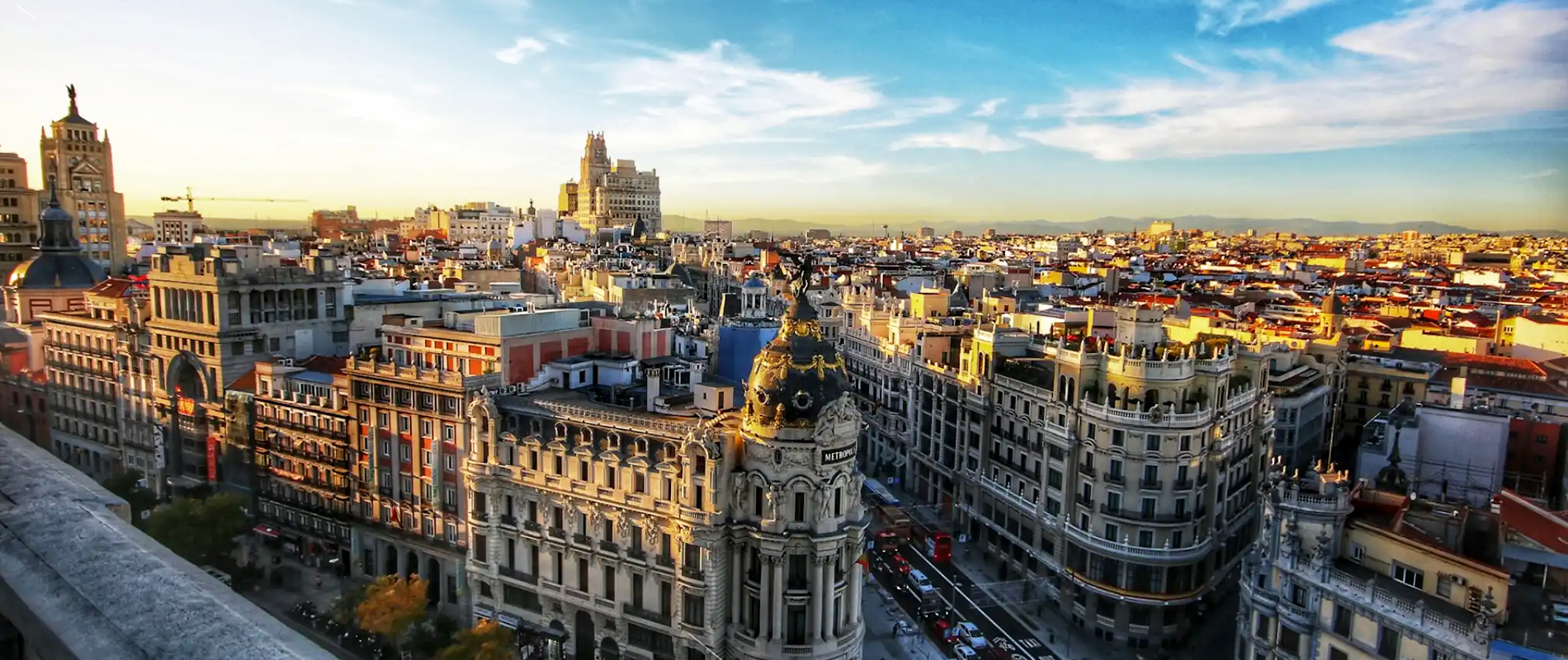
Spain's capital and most populated city is Madrid. There are about 3.5 million people living there, and there are about 7 million people living in the metropolitan region. Its metropolitan area is the second largest in the European Union (EU), and it is the second-largest city in the EU, behind Berlin, Germany.The municipality's total land area is 604.3 km² (233.3 sq mi).At roughly 650 meters (2,130 feet) above mean sea level, Madrid is located on the River Manzanares in the center of the Iberian Peninsula. As the capital of Spain and the nearby autonomous community of Madrid (since 1983), it serves as the nation's political, economic, and cultural hub. Under the Emirate of Córdoba, Madrid's rudimentary walled military outpost was established in the late ninth century. After being overrun by Christians in 1083 or 1085, it became a major town under the Crown of Castile in the Late Middle Ages. As the permanent location of the Hispanic Monarchy's court, Madrid's growth as an administrative hub was encouraged after 1561. The location of contemporary In addition to Roman villas, a Visigoth basilica close to the church of Santa María de la Almudena, three Visigoth necropolises close to Casa de Campo, Tetuán, and Vicálvaro, and archeological remnants of the Celtic Carpetani town, Madrid has been inhabited from prehistoric times. By 1594, there were 37,500 people living in the city, up from 4,060 in 1530. Ex-soldiers, foreigners, rogues, and Ruanes made up the court's impoverished populace, who were unhappy with the expensive and scarce food. Phillip II established his court at the old alcázar in Madrid in June of 1561. With the exception of a brief period between 1601 and 1606, when the Court was moved to Valladolid (and the Madrid population briefly fell proportionally), Madrid became the political hub of the kingdom as a result. Madrid was affirmed as Spain's capital by the 1978 constitution following the overthrow of the Francoist government. The first democratically elected mayor of Madrid since the Second Republic took office in the 1979 municipal election. Some of the most significant events of the era took place in Madrid, including the large-scale protests in support of democracy following the failed coup attempt, 23-F, on February 23, 1981. The center-left PSOE was represented by the first democratic mayors, Enrique Tierno Galván and Juan Barranco Gallardo. Madrid became the epicenter of the la Movida cultural movement in the late 1970s and early 1980s. On the other hand, in the 1980s, a heroin epidemic affected Madrid's impoverished areas, as it did throughout the nation.
Maasai Mara Africa
Maasai Mara Africa
Africa
AFRICAN
Yes
38
Maasai Mara, frequently spelled Masai Mara, and referred to locals as just "The Mara," is a sizable national game reserve in Kenya's Narok County that borders Tanzania's Serengeti National Park. The Maasai people, the region's original occupants who came from the Nile Basin, are honored by the name. From a distance, their description of the region is as follows: "Mara" means "spotted" in the Maa language due to the short, bushy trees that are scattered throughout the terrain. With its populations of lions, leopards, cheetahs, and African bush elephants, the Maasai Mara is one of Africa's wilderness and wildlife protection areas. In addition, it is home to the Great Migration, which has earned it a spot among the ten Wonders of the World and the Seven Natural Wonders of Africa. Depending on the weather, the Great Migration often takes place in July when a huge number of wildebeest migrate from Tanzania across the Mara River. The Maasai Mara National Reserve, the Mara Triangle, a number of Maasai group ranches, and Maasai Mara conservancies are all included in the Greater Mara ecosystem. The Masai Mara, sometimes referred to as "the world's eight world wonders" or one of the most well-known wildlife places in the world, is home to an abundance of species, breathtaking views, and unending plains.The Masai Mara National Reserve, an unfenced reserve with unrestricted wildlife movement, and a number of conservancies comprise the Greater Masai Mara area. Maasai families privately own these parcels of land. The Maasai families who lease their property to safari lodges have the opportunity to use the money they make from the conservancies to fund development or education projects in their communities. The Masai Mara was called in honour of the Maasai people, the traditional residents of the area. 'Mara' means'spotted' in Maasai (Maa) dialect. It won't be difficult to comprehend how the Masai Mara gained its name after visiting. The terrain does appear somewhat'spotted' due to the small, bushy trees that dot it. The environment of the Greater Masai Mara is enormous. It is almost 1510 square kilometers in size. The Serengeti National Park in Tanzania is adjacent to the Maasai Mara, a sizable game reserve in Narok County, Kenya. It is named after the Maasai people, who were the original occupants of the region, and how they described it from a distance: "Mara" means "spotted" in the Maasai language, referring to the numerous trees, plants, cloud shadows, and animals that dotted the terrain.


 (1).jpg)

.jpg)

.jpg)


.jpg)