Ho Chi Minh Vietnam
Ho Chi Minh Vietnam
Vietnam
ASIA
Yes
21
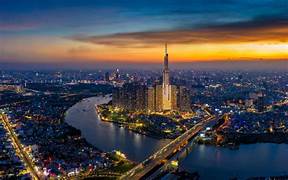
"With 14,002,598 residents as of 2025, Ho Chi Minh City, usually referred to as Saigon, is the most populated city in Vietnam. The Saigon River is the greatest of the rivers and canals that characterize the city's topography. Approximately 25% of Vietnam's total GDP comes from Ho Chi Minh City, the country's major financial hub and the province and municipality with the highest gross regional product [7].[8] The metropolitan area of Ho Chi Minh City has the greatest economy outside of an ASEAN nation capital and ranks fifth in ASEAN. Due to Đại Việt's expansionist policy of Nam tiến, the region was first a part of Cambodian states until joining the Vietnamese Nguyễn lords in 1698. At the end of their existence, before the Nguyễn dynasty was established, it served as the capital of the Nguyễn lords. From 1862 until 1949, it served as the capital of French Cochinchina following the collapse of the Citadel of Saigon. The Independence Palace, Bitexco Financial Tower, Landmark 81 Tower, the War Remnants Museum, and Bến Thành Market are just a few of the city's modern and historic landmarks that draw tourists. The Phạm Ngũ Lão Ward and the Bùi Viện street within the ward are noteworthy examples of the city's busy nightlife and winding, pedestrian-friendly lanes. Tân Sơn Nhất International Airport serves the city and is the biggest airport in Vietnam in terms of the number of passengers it handles. In 2010, it handled an estimated 15.5 million passengers annually, which accounted for more than half of all air travel in Vietnam. In 2025, Long Thành International Airport is expected to open for business. Tân Sơn Nhất Airport will handle domestic flights, while Long Thành Airport, located in Long Thành District, Đồng Nai Province, approximately 40 km (25 mi) east of Ho Chi Minh City, would handle international flights. When finished, it can handle up to 100 million passengers annually. Additionally, the city serves as a station for numerous Vietnam Railways train routes throughout the nation. From Saigon Railway Station in District 3, the Reunification Express (tàu Thống Nhất) travels to Hanoi, making stops in cities and provinces en route. Sóng Thần and Sài Gòn are the two primary stations in the city. There are also a number of minor stations, including Thủ Đức, Bình Triệu, Gò Vấp, and Dĩ An. Nevertheless, rail transportation is still in its infancy and currently accounts for just 0.6% of passenger traffic and 6% of cargo exports. Because of its history, both Western and Eastern styles have typically served as inspiration for artwork. The Ho Chi Minh City Museum of Fine Arts and other art galleries on Nam Kỳ Khởi Nghĩa street, Trần Phú street, and Bùi Viện street are well-known places to see art in Ho Chi Minh City. There are several association football clubs in the city. Ho Chi Minh City F.C., one of the biggest clubs in the city, is situated at Thống Nhất Stadium. Previously known as Cảng Sài Gòn, they won the V.League 1 championship four times (in 1986, 1993–94, 1997, and 2001–02). Originally known as Quân Khu 4, Navibank Saigon F.C. was headquartered at Thống Nhất Stadium and won the First Division in 2008. The team was then promoted to the V-League in 2009, but it was disbanded due to a corruption controversy."
Kruger National Park Africa
Kruger National Park Africa
Africa
AFRICAN
Yes
37
Covering 19,623 km2 (7,576 sq mi), Kruger National Park is located in the northeastern South African provinces of Mpumalanga and Limpopo. It stretches 65 km (40 mi) from east to west and 360 km (220 mi) from north to south. Skukuza is home to the administrative headquarters. The South African Republic's government first protected portions of the park in 1898, and in 1926 it was designated as the country's first national park. It is a part of the biosphere reserve known as the Kruger to Canyons Biosphere. Kruger National Park is home to all five of the big game creatures and boasts 147 species of large mammals, more than any other game reserve in Africa. Webcams have been installed to watch the wildlife. There are believed to be just 400 African wild dog packs in all of South Africa, and Kruger is home to packs of these endangered animals. There is a reasonably consistent group of bird species from the park's southern to central regions, but the mopane-dominated flatlands north of the Olifants show a fall in richness.The larger birds of prey, on the other hand, breed during the dry winter, when their prey is most exposed, whereas the majority of species breed during the summer, when rainfall sustain the majority of vegetable and animal food. In 1918, Kruger National Park was declared, and a commission was formed to oversee its development and planning. A government officer named Johannes Andries (Dries) de Ridder served as the commission's first secretary. After 44 years in charge of the Kruger Park, Warden James Stevenson-Hamilton retired on April 30, 1946. Colonel J. A. B. Sandenbergh of the South African Air Force took his post. The government forcibly removed the Makuleke people from the northern portion of the park in 1969, and approximately 1500 of them were relocated to territory in the south so that their original tribal lands could be incorporated into the larger Kruger National Park. The famed Big Five (lion, leopard, elephant, rhinoceros, and buffalo) are among the remarkably diverse species that makes Kruger National Park famous. The park, which spans about two million hectares, draws tourists from all around the world with its unmatched wildlife viewing opportunities.


 (1).jpg)

.jpg)

.jpg)


.jpg)