Bangkok Thailand
Bangkok Thailand
Thailand
ASIA
Yes
22
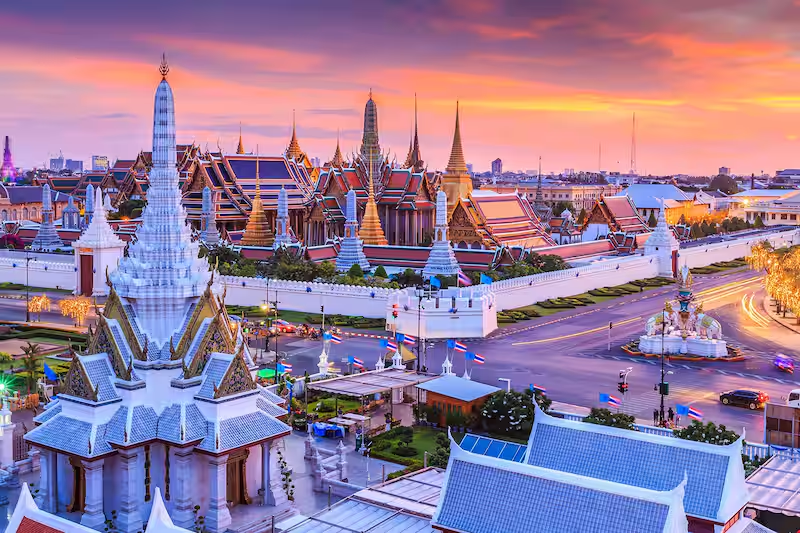
"Bangkok, Thailand's capital and most populated city, is formally known as Krung Thep Maha Nakhon[b] and is commonly referred to as Krung Thep[c]. With an anticipated 10 million residents as of 2024, the city makes approximately 13% of Thailand's total population and is located in the Chao Phraya River delta in central Thailand, covering 1,568.7 square kilometers (605.7 sq mi). According to the 2021 estimate, the Bangkok Metropolitan Region is home to around 17.4 million people, or 25% of Thailand's total population. This makes Bangkok a megacity and an extreme primate city, surpassing all other urban centers in Thailand in terms of both size and economic significance. In the 15th century, during the Ayutthaya period, Bangkok began as a tiny trading port. Over time, it expanded and became the location of two capital cities: Thonburi in 1767 and Rattanakosin in 1782. As Siam was under pressure from the West in the late 19th century, Bangkok was at the center of the country's development. Throughout the 20th century, the city was at the epicenter of the nation's political conflicts as Siam (later renamed Thailand) abolished absolute monarchy, embraced constitutional government, and experienced multiple upheavals and coups. Bangkok's culture is a reflection of its status as Thailand's hub for modernization and riches. The city has traditionally served as a gateway for Western ideas and material products, which its citizens have embraced and incorporated to varying degrees with Thai values. The lifestyles of the growing middle class best illustrate this. Shopping malls are popular weekend destinations, and conspicuous consumption is a sign of social and economic standing. Many of Thailand's yearly festivities are observed by Bangkok locals. Traditional ceremonies and water fights are held all around the city during Songkran, which takes place from April 13 to 15. Typically held in November, Loi Krathong is accompanied by the Golden Mount Fair. The plaza in front of CentralWorld is the most well-known location for New Year's celebrations. In addition to domestic flights to and from Bangkok's two international airports (Suvarnabhumi and Don Mueang), the country's roadway and rail networks connect Bangkok to the rest of the nation. Khlong Toei Port is continuously used for its centuries-old maritime cargo transportation.
Phi Phi Island
Phi Phi Island
Thailand
ASIA
Yes
19
"The Phi Phi Islands are a series of islands in Thailand that lie between the Straits of Malacca and the big island of Krabi. Krabi Province is the administrative home of the islands. The largest and most populous island in the group is Ko Phi Phi Don, while many tourists also visit the beaches of Ko Phi Phi Le, the second-largest island. Large limestone rocks protruding from the water characterize the remaining islands in the group, such as Bida Nok, Bida Nai, and Ko Mai Phai. Ferries, speedboats, and long-tail boats can get to the islands; they usually depart from Krabi town or from ports in Phuket Province. Between the large island of Krabi and the Straits of Malacca, Thailand, lies a group of islands known as the Phi Phi Islands. The islands' administrative center is Krabi Province. Ko Phi Phi Don is the group's largest and most populated island, while Ko Phi Phi Le, the second-largest island, also has a lot of tourists visiting its beaches. The other islands in the group, including Bida Nok, Bida Nai, and Ko Mai Phai, are characterized by large limestone boulders that rise out of the ocean. The islands are accessible by ferry, speedboat, and long-tail boat; these vessels often leave from ports ain Phuket Province or Krabi town. When Ko Phi Phi Le served as the setting for the British-American movie The Beach in 2000, the islands gained international recognition. This sparked controversy, with some claiming that the film studio had harmed the island's natural ecosystem by planting palm trees and razing beach sections to make the island more like the book's descriptions. The filmmakers deny these claims. The publication of the movie was said to have increased tourism, which in turn led to more environmental damage. The ""Viking Cave"" on Phi Phi Le is the site of a flourishing industry that harvests edible bird nests. Tropical monsoon winds impact Hat Noppharat Thara–Mu Ko Phi Phi National Park. There are two distinct seasons: the hot season, which lasts from January to April, and the rainy season, which lasts from May to December. The typical temperature is between 17 and 37 °C (63 and 99 °F). There is an average of 2,231 millimeters (87.8 inches) of rainfall annually, with February being the driest month and July being the wettest. Krabi, which is in the same province as the Phi Phi Islands, has the closest airport. The airports at Phuket and Trang are also close by. Road and boat connections to Phuket are direct. From Trang to Phi Phi, there is a road and boat connection via Koh Lanta; however, services are only available from November to March. Phuket, Ko Lanta, and Krabi all have regular ferry boats to Ko Phi Phi.

 (1).jpg)

.jpg)

.jpg)


