Bangkok Thailand
Bangkok Thailand
Thailand
ASIA
Yes
22
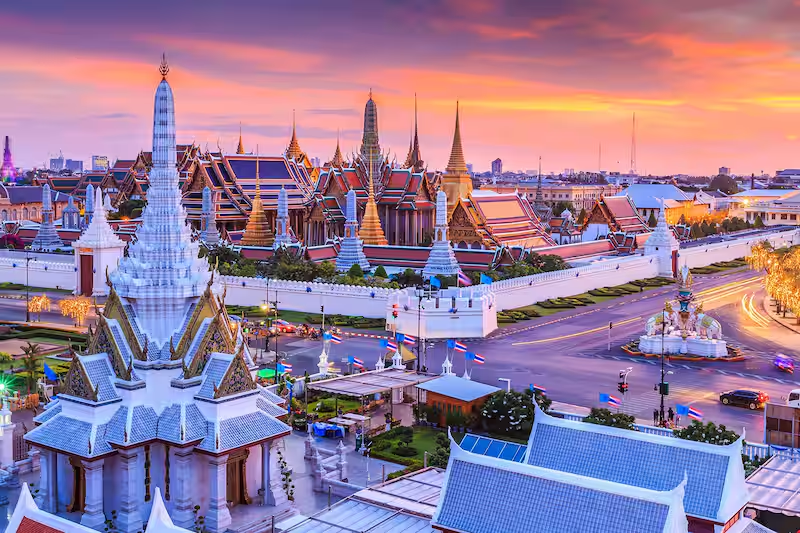
"Bangkok, Thailand's capital and most populated city, is formally known as Krung Thep Maha Nakhon[b] and is commonly referred to as Krung Thep[c]. With an anticipated 10 million residents as of 2024, the city makes approximately 13% of Thailand's total population and is located in the Chao Phraya River delta in central Thailand, covering 1,568.7 square kilometers (605.7 sq mi). According to the 2021 estimate, the Bangkok Metropolitan Region is home to around 17.4 million people, or 25% of Thailand's total population. This makes Bangkok a megacity and an extreme primate city, surpassing all other urban centers in Thailand in terms of both size and economic significance. In the 15th century, during the Ayutthaya period, Bangkok began as a tiny trading port. Over time, it expanded and became the location of two capital cities: Thonburi in 1767 and Rattanakosin in 1782. As Siam was under pressure from the West in the late 19th century, Bangkok was at the center of the country's development. Throughout the 20th century, the city was at the epicenter of the nation's political conflicts as Siam (later renamed Thailand) abolished absolute monarchy, embraced constitutional government, and experienced multiple upheavals and coups. Bangkok's culture is a reflection of its status as Thailand's hub for modernization and riches. The city has traditionally served as a gateway for Western ideas and material products, which its citizens have embraced and incorporated to varying degrees with Thai values. The lifestyles of the growing middle class best illustrate this. Shopping malls are popular weekend destinations, and conspicuous consumption is a sign of social and economic standing. Many of Thailand's yearly festivities are observed by Bangkok locals. Traditional ceremonies and water fights are held all around the city during Songkran, which takes place from April 13 to 15. Typically held in November, Loi Krathong is accompanied by the Golden Mount Fair. The plaza in front of CentralWorld is the most well-known location for New Year's celebrations. In addition to domestic flights to and from Bangkok's two international airports (Suvarnabhumi and Don Mueang), the country's roadway and rail networks connect Bangkok to the rest of the nation. Khlong Toei Port is continuously used for its centuries-old maritime cargo transportation.
Kruger National Park Africa
Kruger National Park Africa
Africa
AFRICAN
Yes
37
Covering 19,623 km2 (7,576 sq mi), Kruger National Park is located in the northeastern South African provinces of Mpumalanga and Limpopo. It stretches 65 km (40 mi) from east to west and 360 km (220 mi) from north to south. Skukuza is home to the administrative headquarters. The South African Republic's government first protected portions of the park in 1898, and in 1926 it was designated as the country's first national park. It is a part of the biosphere reserve known as the Kruger to Canyons Biosphere. Kruger National Park is home to all five of the big game creatures and boasts 147 species of large mammals, more than any other game reserve in Africa. Webcams have been installed to watch the wildlife. There are believed to be just 400 African wild dog packs in all of South Africa, and Kruger is home to packs of these endangered animals. There is a reasonably consistent group of bird species from the park's southern to central regions, but the mopane-dominated flatlands north of the Olifants show a fall in richness.The larger birds of prey, on the other hand, breed during the dry winter, when their prey is most exposed, whereas the majority of species breed during the summer, when rainfall sustain the majority of vegetable and animal food. In 1918, Kruger National Park was declared, and a commission was formed to oversee its development and planning. A government officer named Johannes Andries (Dries) de Ridder served as the commission's first secretary. After 44 years in charge of the Kruger Park, Warden James Stevenson-Hamilton retired on April 30, 1946. Colonel J. A. B. Sandenbergh of the South African Air Force took his post. The government forcibly removed the Makuleke people from the northern portion of the park in 1969, and approximately 1500 of them were relocated to territory in the south so that their original tribal lands could be incorporated into the larger Kruger National Park. The famed Big Five (lion, leopard, elephant, rhinoceros, and buffalo) are among the remarkably diverse species that makes Kruger National Park famous. The park, which spans about two million hectares, draws tourists from all around the world with its unmatched wildlife viewing opportunities.


 (1).jpg)
.jpg)

.jpg)


.jpg)