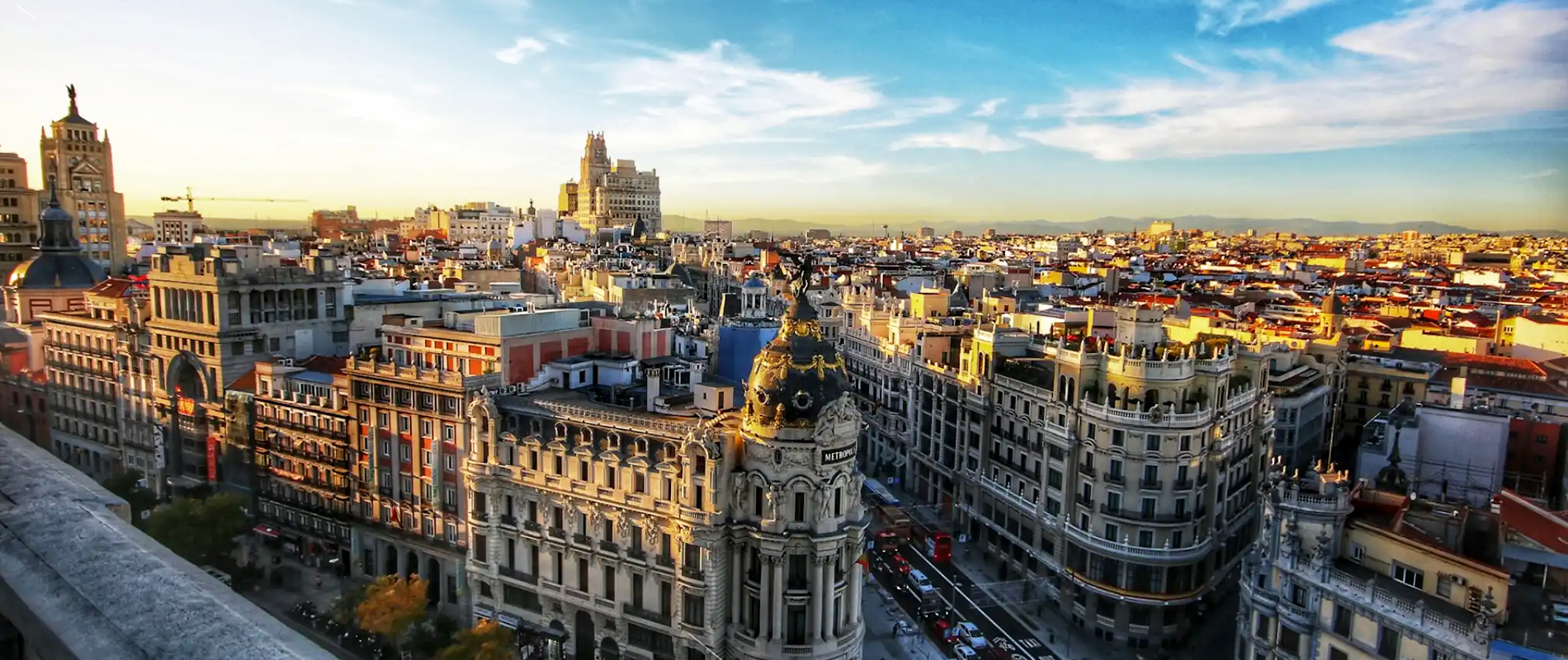
Madrid Spain
Madrid Spain
Spain
EUROPE
Yes
25
Spain's capital and most populated city is Madrid. There are about 3.5 million people living there, and there are about 7 million people living in the metropolitan region. Its metropolitan area is the second largest in the European Union (EU), and it is the second-largest city in the EU, behind Berlin, Germany.The municipality's total land area is 604.3 km² (233.3 sq mi).At roughly 650 meters (2,130 feet) above mean sea level, Madrid is located on the River Manzanares in the center of the Iberian Peninsula. As the capital of Spain and the nearby autonomous community of Madrid (since 1983), it serves as the nation's political, economic, and cultural hub. Under the Emirate of Córdoba, Madrid's rudimentary walled military outpost was established in the late ninth century. After being overrun by Christians in 1083 or 1085, it became a major town under the Crown of Castile in the Late Middle Ages. As the permanent location of the Hispanic Monarchy's court, Madrid's growth as an administrative hub was encouraged after 1561. The location of contemporary In addition to Roman villas, a Visigoth basilica close to the church of Santa María de la Almudena, three Visigoth necropolises close to Casa de Campo, Tetuán, and Vicálvaro, and archeological remnants of the Celtic Carpetani town, Madrid has been inhabited from prehistoric times. By 1594, there were 37,500 people living in the city, up from 4,060 in 1530. Ex-soldiers, foreigners, rogues, and Ruanes made up the court's impoverished populace, who were unhappy with the expensive and scarce food. Phillip II established his court at the old alcázar in Madrid in June of 1561. With the exception of a brief period between 1601 and 1606, when the Court was moved to Valladolid (and the Madrid population briefly fell proportionally), Madrid became the political hub of the kingdom as a result. Madrid was affirmed as Spain's capital by the 1978 constitution following the overthrow of the Francoist government. The first democratically elected mayor of Madrid since the Second Republic took office in the 1979 municipal election. Some of the most significant events of the era took place in Madrid, including the large-scale protests in support of democracy following the failed coup attempt, 23-F, on February 23, 1981. The center-left PSOE was represented by the first democratic mayors, Enrique Tierno Galván and Juan Barranco Gallardo. Madrid became the epicenter of the la Movida cultural movement in the late 1970s and early 1980s. On the other hand, in the 1980s, a heroin epidemic affected Madrid's impoverished areas, as it did throughout the nation.
Kruger National Park Africa
Kruger National Park Africa
Africa
AFRICAN
Yes
37
Covering 19,623 km2 (7,576 sq mi), Kruger National Park is located in the northeastern South African provinces of Mpumalanga and Limpopo. It stretches 65 km (40 mi) from east to west and 360 km (220 mi) from north to south. Skukuza is home to the administrative headquarters. The South African Republic's government first protected portions of the park in 1898, and in 1926 it was designated as the country's first national park. It is a part of the biosphere reserve known as the Kruger to Canyons Biosphere. Kruger National Park is home to all five of the big game creatures and boasts 147 species of large mammals, more than any other game reserve in Africa. Webcams have been installed to watch the wildlife. There are believed to be just 400 African wild dog packs in all of South Africa, and Kruger is home to packs of these endangered animals. There is a reasonably consistent group of bird species from the park's southern to central regions, but the mopane-dominated flatlands north of the Olifants show a fall in richness.The larger birds of prey, on the other hand, breed during the dry winter, when their prey is most exposed, whereas the majority of species breed during the summer, when rainfall sustain the majority of vegetable and animal food. In 1918, Kruger National Park was declared, and a commission was formed to oversee its development and planning. A government officer named Johannes Andries (Dries) de Ridder served as the commission's first secretary. After 44 years in charge of the Kruger Park, Warden James Stevenson-Hamilton retired on April 30, 1946. Colonel J. A. B. Sandenbergh of the South African Air Force took his post. The government forcibly removed the Makuleke people from the northern portion of the park in 1969, and approximately 1500 of them were relocated to territory in the south so that their original tribal lands could be incorporated into the larger Kruger National Park. The famed Big Five (lion, leopard, elephant, rhinoceros, and buffalo) are among the remarkably diverse species that makes Kruger National Park famous. The park, which spans about two million hectares, draws tourists from all around the world with its unmatched wildlife viewing opportunities.


 (1).jpg)

.jpg)

.jpg)


.jpg)