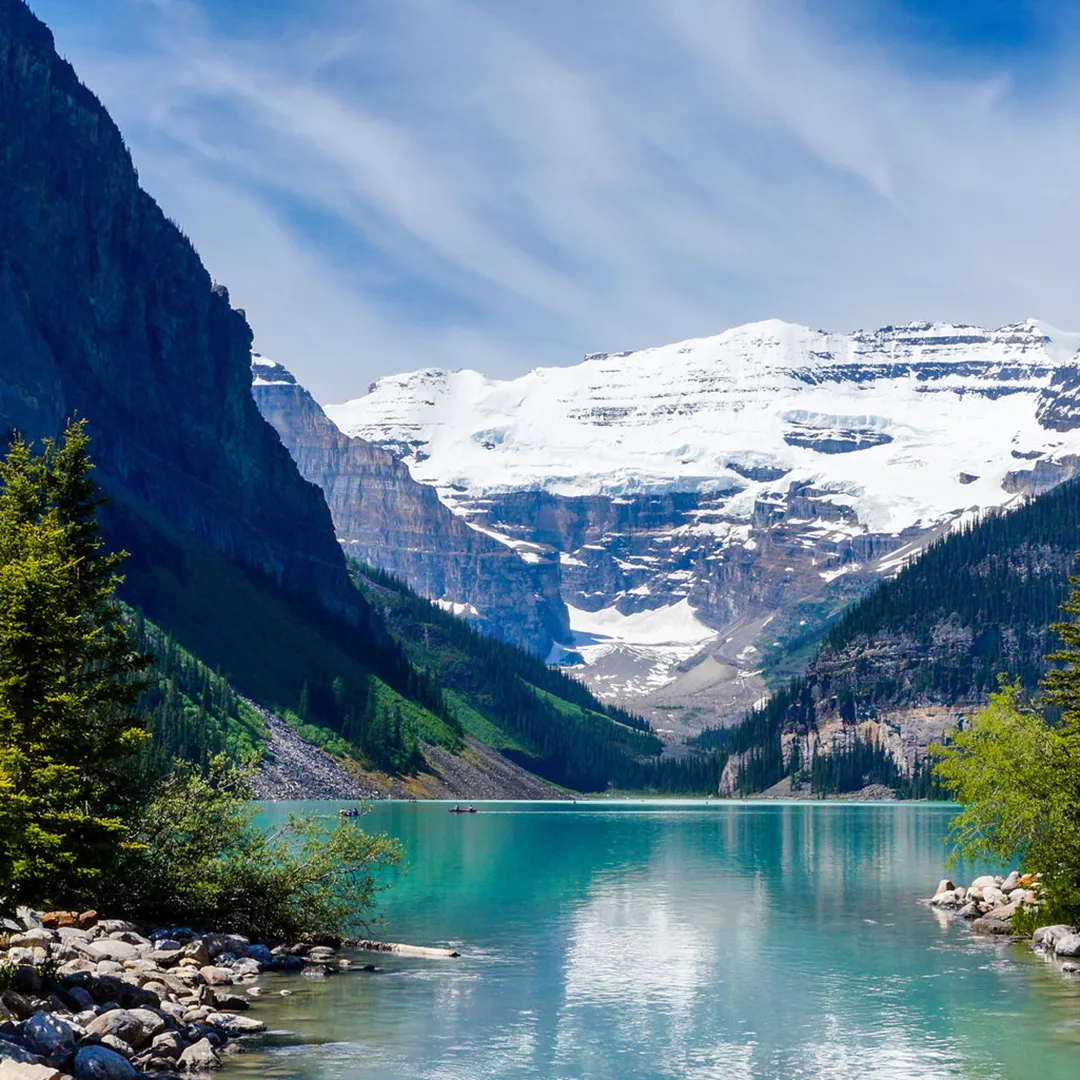
Lake Louise Canada
Lake Louise Canada
Canada
NORTH AMERICA
Yes
13
"The Canadian hamlet of Lake Louise is located in Alberta's Banff National Park. Located on the Bow River in Alberta's Rockies, 3 km (1.9 mi) northeast of the lake with the same name, it is named for Princess Louise, Duchess of Argyll. Originally established in 1884 as a Canadian Pacific Railway outpost, Lake Louise is Canada's highest community at 1,600 meters (5,200 feet) above sea level. The climate of Lake Louise is subarctic (Köppen climatic classification Dfc). The average annual snowfall is 279.1 cm (109.9 in), and while winter temperatures can drop below -50 °C (-58 °F), they often hover around -18.4 °C (-1.1 °F) in January and -17.6 °C (-0.3 °F) in February. Summers are characterized by chilly, crisp days and icy mornings. In each month of the year, snowfall is possible. It may also be referred to as a subalpine climate because lower elevations on that latitude have humid continental climates instead. The frost-free period is only 14 days on average due to the high altitude and significant diurnal air temperature change. According to Statistics Canada's 2011 Census of Population, Lake Louise had 691 residents.Workers in the tourism and service sectors frequently relocate to the area for employment, so the population frequently changes from year to year. While Highway 1A starts at the community's entrance, the Trans-Canada Highway (Highway 1) runs alongside the community. Just north of the village is the southernmost point of Highway 93, also known as the Icefields Parkway. The foothills of the Rocky Mountains, including what is now Lake Louise, were inhabited exclusively by local indigenous peoples before European settlers arrived. They hunted the once-common bison, as well as elk, moose, and other big and small game animals, as well as fished the area's abundant waterways and foraged the area's numerous edible and medicinal plant species. The Canadian Pacific Railway (CPR), which would pass through Bow Valley, started construction in the 1870s. The site was named 'Emerald Lake' by CPR worker Tom Wilson, who visited it in 1882 with a Nakoda guide. Afterwards, the hamlet was referred to as ""Holt City,"" ""Laggan,"" and finally, ""Lake Louise."" Although a CPR station from around 1890 was replaced in 1910, the railway company kept using it for other uses until 1976, when it was given to Calgary's Heritage Park Historical Village. The depot was relocated to the park and renovated in the manner of the time when the village was known as Laggan. Because of its excellent preservation and current use as a restaurant, the 1910 station was designated a heritage railway station by the federal government in 1991. Since its 1892 addition to Rocky Mountains Park, Lake Louise has grown to become a popular international tourist attraction thanks to its proximity to the Trans-Canada Highway.
Maasai Mara Africa
Maasai Mara Africa
Africa
AFRICAN
Yes
38
Maasai Mara, frequently spelled Masai Mara, and referred to locals as just "The Mara," is a sizable national game reserve in Kenya's Narok County that borders Tanzania's Serengeti National Park. The Maasai people, the region's original occupants who came from the Nile Basin, are honored by the name. From a distance, their description of the region is as follows: "Mara" means "spotted" in the Maa language due to the short, bushy trees that are scattered throughout the terrain. With its populations of lions, leopards, cheetahs, and African bush elephants, the Maasai Mara is one of Africa's wilderness and wildlife protection areas. In addition, it is home to the Great Migration, which has earned it a spot among the ten Wonders of the World and the Seven Natural Wonders of Africa. Depending on the weather, the Great Migration often takes place in July when a huge number of wildebeest migrate from Tanzania across the Mara River. The Maasai Mara National Reserve, the Mara Triangle, a number of Maasai group ranches, and Maasai Mara conservancies are all included in the Greater Mara ecosystem. The Masai Mara, sometimes referred to as "the world's eight world wonders" or one of the most well-known wildlife places in the world, is home to an abundance of species, breathtaking views, and unending plains.The Masai Mara National Reserve, an unfenced reserve with unrestricted wildlife movement, and a number of conservancies comprise the Greater Masai Mara area. Maasai families privately own these parcels of land. The Maasai families who lease their property to safari lodges have the opportunity to use the money they make from the conservancies to fund development or education projects in their communities. The Masai Mara was called in honour of the Maasai people, the traditional residents of the area. 'Mara' means'spotted' in Maasai (Maa) dialect. It won't be difficult to comprehend how the Masai Mara gained its name after visiting. The terrain does appear somewhat'spotted' due to the small, bushy trees that dot it. The environment of the Greater Masai Mara is enormous. It is almost 1510 square kilometers in size. The Serengeti National Park in Tanzania is adjacent to the Maasai Mara, a sizable game reserve in Narok County, Kenya. It is named after the Maasai people, who were the original occupants of the region, and how they described it from a distance: "Mara" means "spotted" in the Maasai language, referring to the numerous trees, plants, cloud shadows, and animals that dotted the terrain.


 (1).jpg)

.jpg)

.jpg)


.jpg)