Brisbane Australia
Brisbane Australia
Australia
AUSTRALIA
Yes
20
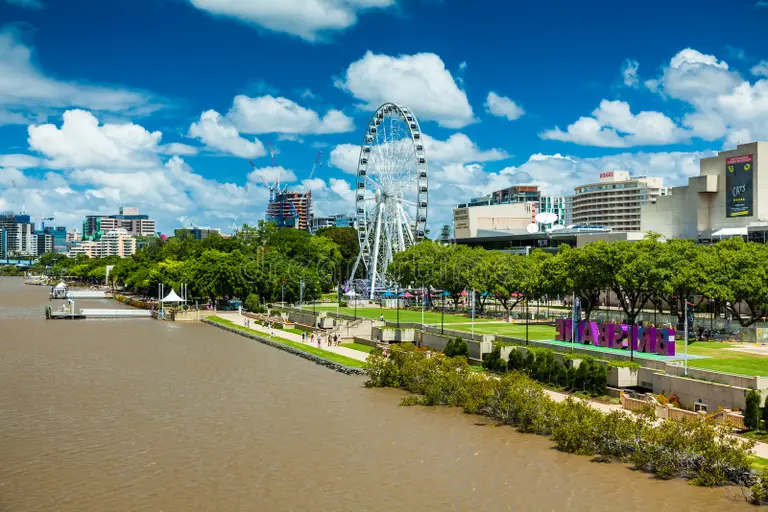
"Brisbane, Australia's third-largest city, is a port and the capital of Queensland. It is located 12 miles (19 km) above the Brisbane River's mouth in Moreton Bay on the southern slopes of the Taylor Range. John Oxley originally visited the location in 1823, and a prison colony moved there from Redcliffe (22 miles [35 km] northeast) in 1824. When the convict settlement was proclaimed a town in 1834, the original name, Edenglassie, was altered to honor Thomas Makdougall Brisbane, governor of New South Wales (1821–25). Until the colony's punitive purpose was discontinued in 1839, freemen were officially prohibited from settling within 50 miles (80 km) of the colony; nevertheless, this prohibition was ineffectual. Produce is transported from a broad agricultural hinterland that stretches west to the Eastern Highlands, the Darling Downs, and beyond via Brisbane's numerous rail lines and roadways. Wool, grains, dairy products, meat, sugar, preserved goods, and mineral sands are all exported via the city's port, which can handle ships weighing up to 34,000 tons. With almost half of the state's manufacturing capacity, the industrialized metropolitan region is home to heavy and light engineering facilities, food processing facilities, shipyards, oil refineries, sawmills, and industries that produce rubber goods, cars, cement, and fertilizer. Natural gas and oil are piped from wells in Roma (northwest) and Moonie (west). The Somerset Dam, the Mount Crosby Weir, and Lake Manchester provide the water. The University of Queensland at St. Lucia (1909), Griffith University (1971), Parliament House (1869), the state museum (1855) and art gallery (1895), Anglican and Roman Catholic cathedrals, numerous parks, and gardens are all located within the city, which is divided in half by a number of bridges and ferries. The greatest flood to hit the city since 1974 occurred in January 2011, when the Brisbane River spilled its banks following an extended period of intense rain. Population (2001): 873,780; Brisbane Statistical Division: 1,627,535; 2006: 956,129; Brisbane Statistical Division: 1,763,131: local government area. Brisbane is home to the headquarters of three major universities: The University of Queensland (UQ), the oldest university in Queensland and one that regularly appears in the top 50 worldwide .Kelvin Grove Griffith University (GU), with campuses in Nathan, Mount Gravatt, South Bank, and Meadowbrook; and Queensland University of Technology (QUT), with campuses in the central business area (Gardens Point) and St. Lucia, Herston, and Gatton .Brisbane boasts a vast transportation system that connects the city to regional hubs, interstate routes, and international locations. Private vehicles are the most common form of transportation in this city, as they are throughout all of Australia. Translink, which offers a single ticketing and electronic payment system (referred to as the ""go card"") for South East Queensland, coordinates the country's rail, bus, and ferry services. The built-up part of Brisbane is located within zones 1–3, which are the seven fare zones that radiate outward from the central business district (CBD). While trains and ferries are run by governmental organizations, bus services are run by both private and public companies.
Maasai Mara Africa
Maasai Mara Africa
Africa
AFRICAN
Yes
38
Maasai Mara, frequently spelled Masai Mara, and referred to locals as just "The Mara," is a sizable national game reserve in Kenya's Narok County that borders Tanzania's Serengeti National Park. The Maasai people, the region's original occupants who came from the Nile Basin, are honored by the name. From a distance, their description of the region is as follows: "Mara" means "spotted" in the Maa language due to the short, bushy trees that are scattered throughout the terrain. With its populations of lions, leopards, cheetahs, and African bush elephants, the Maasai Mara is one of Africa's wilderness and wildlife protection areas. In addition, it is home to the Great Migration, which has earned it a spot among the ten Wonders of the World and the Seven Natural Wonders of Africa. Depending on the weather, the Great Migration often takes place in July when a huge number of wildebeest migrate from Tanzania across the Mara River. The Maasai Mara National Reserve, the Mara Triangle, a number of Maasai group ranches, and Maasai Mara conservancies are all included in the Greater Mara ecosystem. The Masai Mara, sometimes referred to as "the world's eight world wonders" or one of the most well-known wildlife places in the world, is home to an abundance of species, breathtaking views, and unending plains.The Masai Mara National Reserve, an unfenced reserve with unrestricted wildlife movement, and a number of conservancies comprise the Greater Masai Mara area. Maasai families privately own these parcels of land. The Maasai families who lease their property to safari lodges have the opportunity to use the money they make from the conservancies to fund development or education projects in their communities. The Masai Mara was called in honour of the Maasai people, the traditional residents of the area. 'Mara' means'spotted' in Maasai (Maa) dialect. It won't be difficult to comprehend how the Masai Mara gained its name after visiting. The terrain does appear somewhat'spotted' due to the small, bushy trees that dot it. The environment of the Greater Masai Mara is enormous. It is almost 1510 square kilometers in size. The Serengeti National Park in Tanzania is adjacent to the Maasai Mara, a sizable game reserve in Narok County, Kenya. It is named after the Maasai people, who were the original occupants of the region, and how they described it from a distance: "Mara" means "spotted" in the Maasai language, referring to the numerous trees, plants, cloud shadows, and animals that dotted the terrain.


 (1).jpg)

.jpg)

.jpg)


.jpg)