Brisbane Australia
Brisbane Australia
Australia
AUSTRALIA
Yes
20
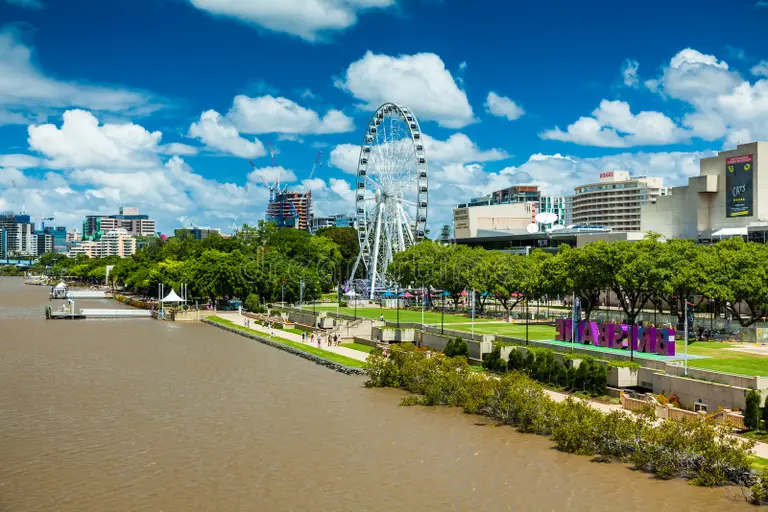
"Brisbane, Australia's third-largest city, is a port and the capital of Queensland. It is located 12 miles (19 km) above the Brisbane River's mouth in Moreton Bay on the southern slopes of the Taylor Range. John Oxley originally visited the location in 1823, and a prison colony moved there from Redcliffe (22 miles [35 km] northeast) in 1824. When the convict settlement was proclaimed a town in 1834, the original name, Edenglassie, was altered to honor Thomas Makdougall Brisbane, governor of New South Wales (1821–25). Until the colony's punitive purpose was discontinued in 1839, freemen were officially prohibited from settling within 50 miles (80 km) of the colony; nevertheless, this prohibition was ineffectual. Produce is transported from a broad agricultural hinterland that stretches west to the Eastern Highlands, the Darling Downs, and beyond via Brisbane's numerous rail lines and roadways. Wool, grains, dairy products, meat, sugar, preserved goods, and mineral sands are all exported via the city's port, which can handle ships weighing up to 34,000 tons. With almost half of the state's manufacturing capacity, the industrialized metropolitan region is home to heavy and light engineering facilities, food processing facilities, shipyards, oil refineries, sawmills, and industries that produce rubber goods, cars, cement, and fertilizer. Natural gas and oil are piped from wells in Roma (northwest) and Moonie (west). The Somerset Dam, the Mount Crosby Weir, and Lake Manchester provide the water. The University of Queensland at St. Lucia (1909), Griffith University (1971), Parliament House (1869), the state museum (1855) and art gallery (1895), Anglican and Roman Catholic cathedrals, numerous parks, and gardens are all located within the city, which is divided in half by a number of bridges and ferries. The greatest flood to hit the city since 1974 occurred in January 2011, when the Brisbane River spilled its banks following an extended period of intense rain. Population (2001): 873,780; Brisbane Statistical Division: 1,627,535; 2006: 956,129; Brisbane Statistical Division: 1,763,131: local government area. Brisbane is home to the headquarters of three major universities: The University of Queensland (UQ), the oldest university in Queensland and one that regularly appears in the top 50 worldwide .Kelvin Grove Griffith University (GU), with campuses in Nathan, Mount Gravatt, South Bank, and Meadowbrook; and Queensland University of Technology (QUT), with campuses in the central business area (Gardens Point) and St. Lucia, Herston, and Gatton .Brisbane boasts a vast transportation system that connects the city to regional hubs, interstate routes, and international locations. Private vehicles are the most common form of transportation in this city, as they are throughout all of Australia. Translink, which offers a single ticketing and electronic payment system (referred to as the ""go card"") for South East Queensland, coordinates the country's rail, bus, and ferry services. The built-up part of Brisbane is located within zones 1–3, which are the seven fare zones that radiate outward from the central business district (CBD). While trains and ferries are run by governmental organizations, bus services are run by both private and public companies.
Cape Town
Cape Town
South Africa
AFRICAN
Yes
35
South Africa's legislative capital is Cape Town. It is the oldest city in the nation and the location of the South African Parliament. Cape Town is the largest city in the Western Cape and the second most populous city in the nation, after Johannesburg.The city is a part of the metropolitan municipality known as the City of Cape Town.Table Mountain, Cape Point, the city's harbor, and its natural environment in the Cape Floristic Region are some of its most well-known features. Numerous publications have ranked Cape Town as the world's greatest city and the finest place to go, including Time Out in 2025, The New York Times in 2014, and The Telegraph for the last eight years (2017–2025). With the greatest concentration of Cape Dutch-style buildings worldwide, Cape Town is renowned for its architectural legacy. Constantia, the historic government buildings in the Central Business District, and Long Street are the best examples of the Cape Dutch architectural style, which blends the architectural traditions of the Netherlands, Germany, France, and Indonesia. Mostert's Mill in Mowbray is the only fully operational windmill in South Africa. Constructed in 1796, it underwent restorations in 1935 and 1995. In 2014, the International Council of Societies of Industrial Design declared Cape Town the World Design Capital. Additionally, Cape Town is designated a "Design City" by the Creative Cities Network of UNESCO. Cape Town's biggest performing arts facility is the Artscape Theatre Centre. The 17th-century savory, sweet, spiced beef dish known as bobotie is one of the foods that originated in Cape Town or is associated with it. A sandwich stuffed with slap chips and other toppings, the Gatsby was initially offered in the Athlone area in 1976 and has since come to represent the city.A classic Cape Malay dessert, the koe'sister is characterized as a cake-like dumpling flavored with cinnamon and topped with a dusting of desiccated coconut. Table Mountain's mass and the chilly Benguela Current of the South Atlantic Ocean both locally alter Cape Town's Mediterranean climate. While the average high temperature is 70°F (21°C) in January and February and the average low temperature is 55°F (13°C) in July, the coast and mountain slopes experience colder weather. Freezing rarely happens. Rainfall occurs on 69 days of the year on average; the southern winter months of June through August account for roughly half of the 26 inches (660 millimeters) of yearly rainfall. Every year, almost five million tons of goods pass through the port of Cape Town. Although ships with a draft of more than 40 feet are not permitted to enter the port during low tide, interoceanic commerce benefits greatly from its dry dock and maintenance facilities. Container traffic is accommodated at the Ben Schoeman Dock.


 (1).jpg)

.jpg)

.jpg)


.jpg)