Alaska US
Alaska US
United States of America
NORTH AMERICA
Yes
16
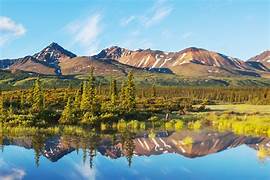
On the northwest edge of North America, Alaska is a non-contiguous state in the United States. It's one of the two non-contiguous U.S. states, together with Hawaii, and it's a part of the Western United States. Alaska is also thought to be the northernmost, westernmost, and easternmost state in the nation, as the Aleutian Islands extend over the 180th meridian into the eastern hemisphere. To the east, it is adjacent to the province of British Columbia and the Canadian territory of Yukon. In the Bering Strait, it has a western maritime boundary with Russia's Chukotka Autonomous Okrug. The Pacific Ocean is to the south, while the Arctic Ocean's Chukchi and Beaufort Seas are to the north. It is the largest exclave in the world and technically a semi-exclave of the United States. With an area larger than the combined areas of the next three largest states—Texas, California, and Montana—Alaska is the largest state in the United States and the seventh-largest subnational division globally. With a population of 740,133 as of 2024, it is the most populous territory in North America, primarily north of the 60th parallel, and more than quadruples the combined populations of Northern Canada and Greenland. It is the third-least populous and sparsest populated state in the United States. Together with Juneau, the state capital, the state is home to the four biggest cities in the US by area. Anchorage is the most populated city in the state, and its metropolitan region is home to around half of Alaska's population. Alaska has been inhabited by indigenous people for thousands of years, and it is generally accepted that the Bering Land Bridge allowed the first North American settlers to arrive in the area. Beginning in the 18th century, the Russian Empire was the first to actively colonize the region, creating Russian America, which included the majority of the present state and supported and preserved a local Alaskan Creole population. It was sold to the United States for US$7.2 million (approximately to $162 million in 2024) in 1867 due to the cost and logistical challenges of maintaining this remote property. Before being formally recognized as a territory on May 11, 1912, the region saw a number of administrative changes. On January 3, 1959, it became the 49th state to join the union. Due to its abundance of natural resources, Alaska, which has one of the smallest state economies, has one of the highest per capita incomes. The state's economy is dominated by commercial fishing, oil and gas extraction, and other activities. The economy is additionally boosted by U.S. military installations and tourism; federally held land, including national forests, national parks, and wildlife refuges, makes up more than half of the state. It was one of the first states to legalize marijuana for recreational use and is also one of the most irreligious. At more than 15 percent, Alaska has the second-highest proportion of Indigenous people in any U.S. state, after Hawaii. The World Ice Art Championships in Fairbanks, the Sitka Whale Fest, the Stikine River Garnet Fest in Wrangell, the Blueberry Festival and Alaska Hummingbird Festival in Ketchikan, and the Iditarod Trail Sled Dog Race from Anchorage to Nome are a few of Alaska's well-liked yearly events. The world's highest population of American bald eagles during the spring is found along the Stikine River. The Alaska Folk Festival, the Fairbanks Summer Arts Festival, the Anchorage Folk Festival, the Athabascan Old-Time Fiddling Festival, the Sitka Jazz Festival, the Sitka Summer Music Festival, and the Anchorage Chamber Music Festival are just a few of Alaska's well-known music events. Although the Juneau Symphony and Fairbanks Symphony Orchestra are equally noteworthy, the Anchorage Symphony Orchestra is the most well-known orchestra in Alaska. Although the state is home to a number of volunteer and semi-professional opera companies, the Anchorage Opera is now the sole professional opera company in the state. Adopted in 1955, ""Alaska's Flag"" is the official state song of Alaska, honoring the state's flag."
Maasai Mara Africa
Maasai Mara Africa
Africa
AFRICAN
Yes
38
Maasai Mara, frequently spelled Masai Mara, and referred to locals as just "The Mara," is a sizable national game reserve in Kenya's Narok County that borders Tanzania's Serengeti National Park. The Maasai people, the region's original occupants who came from the Nile Basin, are honored by the name. From a distance, their description of the region is as follows: "Mara" means "spotted" in the Maa language due to the short, bushy trees that are scattered throughout the terrain. With its populations of lions, leopards, cheetahs, and African bush elephants, the Maasai Mara is one of Africa's wilderness and wildlife protection areas. In addition, it is home to the Great Migration, which has earned it a spot among the ten Wonders of the World and the Seven Natural Wonders of Africa. Depending on the weather, the Great Migration often takes place in July when a huge number of wildebeest migrate from Tanzania across the Mara River. The Maasai Mara National Reserve, the Mara Triangle, a number of Maasai group ranches, and Maasai Mara conservancies are all included in the Greater Mara ecosystem. The Masai Mara, sometimes referred to as "the world's eight world wonders" or one of the most well-known wildlife places in the world, is home to an abundance of species, breathtaking views, and unending plains.The Masai Mara National Reserve, an unfenced reserve with unrestricted wildlife movement, and a number of conservancies comprise the Greater Masai Mara area. Maasai families privately own these parcels of land. The Maasai families who lease their property to safari lodges have the opportunity to use the money they make from the conservancies to fund development or education projects in their communities. The Masai Mara was called in honour of the Maasai people, the traditional residents of the area. 'Mara' means'spotted' in Maasai (Maa) dialect. It won't be difficult to comprehend how the Masai Mara gained its name after visiting. The terrain does appear somewhat'spotted' due to the small, bushy trees that dot it. The environment of the Greater Masai Mara is enormous. It is almost 1510 square kilometers in size. The Serengeti National Park in Tanzania is adjacent to the Maasai Mara, a sizable game reserve in Narok County, Kenya. It is named after the Maasai people, who were the original occupants of the region, and how they described it from a distance: "Mara" means "spotted" in the Maasai language, referring to the numerous trees, plants, cloud shadows, and animals that dotted the terrain.


 (1).jpg)

.jpg)

.jpg)


.jpg)