Alaska US
Alaska US
United States of America
NORTH AMERICA
Yes
16
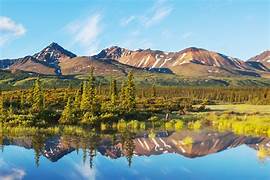
On the northwest edge of North America, Alaska is a non-contiguous state in the United States. It's one of the two non-contiguous U.S. states, together with Hawaii, and it's a part of the Western United States. Alaska is also thought to be the northernmost, westernmost, and easternmost state in the nation, as the Aleutian Islands extend over the 180th meridian into the eastern hemisphere. To the east, it is adjacent to the province of British Columbia and the Canadian territory of Yukon. In the Bering Strait, it has a western maritime boundary with Russia's Chukotka Autonomous Okrug. The Pacific Ocean is to the south, while the Arctic Ocean's Chukchi and Beaufort Seas are to the north. It is the largest exclave in the world and technically a semi-exclave of the United States. With an area larger than the combined areas of the next three largest states—Texas, California, and Montana—Alaska is the largest state in the United States and the seventh-largest subnational division globally. With a population of 740,133 as of 2024, it is the most populous territory in North America, primarily north of the 60th parallel, and more than quadruples the combined populations of Northern Canada and Greenland. It is the third-least populous and sparsest populated state in the United States. Together with Juneau, the state capital, the state is home to the four biggest cities in the US by area. Anchorage is the most populated city in the state, and its metropolitan region is home to around half of Alaska's population. Alaska has been inhabited by indigenous people for thousands of years, and it is generally accepted that the Bering Land Bridge allowed the first North American settlers to arrive in the area. Beginning in the 18th century, the Russian Empire was the first to actively colonize the region, creating Russian America, which included the majority of the present state and supported and preserved a local Alaskan Creole population. It was sold to the United States for US$7.2 million (approximately to $162 million in 2024) in 1867 due to the cost and logistical challenges of maintaining this remote property. Before being formally recognized as a territory on May 11, 1912, the region saw a number of administrative changes. On January 3, 1959, it became the 49th state to join the union. Due to its abundance of natural resources, Alaska, which has one of the smallest state economies, has one of the highest per capita incomes. The state's economy is dominated by commercial fishing, oil and gas extraction, and other activities. The economy is additionally boosted by U.S. military installations and tourism; federally held land, including national forests, national parks, and wildlife refuges, makes up more than half of the state. It was one of the first states to legalize marijuana for recreational use and is also one of the most irreligious. At more than 15 percent, Alaska has the second-highest proportion of Indigenous people in any U.S. state, after Hawaii. The World Ice Art Championships in Fairbanks, the Sitka Whale Fest, the Stikine River Garnet Fest in Wrangell, the Blueberry Festival and Alaska Hummingbird Festival in Ketchikan, and the Iditarod Trail Sled Dog Race from Anchorage to Nome are a few of Alaska's well-liked yearly events. The world's highest population of American bald eagles during the spring is found along the Stikine River. The Alaska Folk Festival, the Fairbanks Summer Arts Festival, the Anchorage Folk Festival, the Athabascan Old-Time Fiddling Festival, the Sitka Jazz Festival, the Sitka Summer Music Festival, and the Anchorage Chamber Music Festival are just a few of Alaska's well-known music events. Although the Juneau Symphony and Fairbanks Symphony Orchestra are equally noteworthy, the Anchorage Symphony Orchestra is the most well-known orchestra in Alaska. Although the state is home to a number of volunteer and semi-professional opera companies, the Anchorage Opera is now the sole professional opera company in the state. Adopted in 1955, ""Alaska's Flag"" is the official state song of Alaska, honoring the state's flag."
Cape Town
Cape Town
South Africa
AFRICAN
Yes
35
South Africa's legislative capital is Cape Town. It is the oldest city in the nation and the location of the South African Parliament. Cape Town is the largest city in the Western Cape and the second most populous city in the nation, after Johannesburg.The city is a part of the metropolitan municipality known as the City of Cape Town.Table Mountain, Cape Point, the city's harbor, and its natural environment in the Cape Floristic Region are some of its most well-known features. Numerous publications have ranked Cape Town as the world's greatest city and the finest place to go, including Time Out in 2025, The New York Times in 2014, and The Telegraph for the last eight years (2017–2025). With the greatest concentration of Cape Dutch-style buildings worldwide, Cape Town is renowned for its architectural legacy. Constantia, the historic government buildings in the Central Business District, and Long Street are the best examples of the Cape Dutch architectural style, which blends the architectural traditions of the Netherlands, Germany, France, and Indonesia. Mostert's Mill in Mowbray is the only fully operational windmill in South Africa. Constructed in 1796, it underwent restorations in 1935 and 1995. In 2014, the International Council of Societies of Industrial Design declared Cape Town the World Design Capital. Additionally, Cape Town is designated a "Design City" by the Creative Cities Network of UNESCO. Cape Town's biggest performing arts facility is the Artscape Theatre Centre. The 17th-century savory, sweet, spiced beef dish known as bobotie is one of the foods that originated in Cape Town or is associated with it. A sandwich stuffed with slap chips and other toppings, the Gatsby was initially offered in the Athlone area in 1976 and has since come to represent the city.A classic Cape Malay dessert, the koe'sister is characterized as a cake-like dumpling flavored with cinnamon and topped with a dusting of desiccated coconut. Table Mountain's mass and the chilly Benguela Current of the South Atlantic Ocean both locally alter Cape Town's Mediterranean climate. While the average high temperature is 70°F (21°C) in January and February and the average low temperature is 55°F (13°C) in July, the coast and mountain slopes experience colder weather. Freezing rarely happens. Rainfall occurs on 69 days of the year on average; the southern winter months of June through August account for roughly half of the 26 inches (660 millimeters) of yearly rainfall. Every year, almost five million tons of goods pass through the port of Cape Town. Although ships with a draft of more than 40 feet are not permitted to enter the port during low tide, interoceanic commerce benefits greatly from its dry dock and maintenance facilities. Container traffic is accommodated at the Ben Schoeman Dock.


 (1).jpg)

.jpg)

.jpg)


.jpg)