Phi Phi Island
Phi Phi Island
Thailand
ASIA
Yes
19
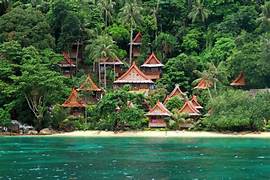
"The Phi Phi Islands are a series of islands in Thailand that lie between the Straits of Malacca and the big island of Krabi. Krabi Province is the administrative home of the islands. The largest and most populous island in the group is Ko Phi Phi Don, while many tourists also visit the beaches of Ko Phi Phi Le, the second-largest island. Large limestone rocks protruding from the water characterize the remaining islands in the group, such as Bida Nok, Bida Nai, and Ko Mai Phai. Ferries, speedboats, and long-tail boats can get to the islands; they usually depart from Krabi town or from ports in Phuket Province. Between the large island of Krabi and the Straits of Malacca, Thailand, lies a group of islands known as the Phi Phi Islands. The islands' administrative center is Krabi Province. Ko Phi Phi Don is the group's largest and most populated island, while Ko Phi Phi Le, the second-largest island, also has a lot of tourists visiting its beaches. The other islands in the group, including Bida Nok, Bida Nai, and Ko Mai Phai, are characterized by large limestone boulders that rise out of the ocean. The islands are accessible by ferry, speedboat, and long-tail boat; these vessels often leave from ports ain Phuket Province or Krabi town. When Ko Phi Phi Le served as the setting for the British-American movie The Beach in 2000, the islands gained international recognition. This sparked controversy, with some claiming that the film studio had harmed the island's natural ecosystem by planting palm trees and razing beach sections to make the island more like the book's descriptions. The filmmakers deny these claims. The publication of the movie was said to have increased tourism, which in turn led to more environmental damage. The ""Viking Cave"" on Phi Phi Le is the site of a flourishing industry that harvests edible bird nests. Tropical monsoon winds impact Hat Noppharat Thara–Mu Ko Phi Phi National Park. There are two distinct seasons: the hot season, which lasts from January to April, and the rainy season, which lasts from May to December. The typical temperature is between 17 and 37 °C (63 and 99 °F). There is an average of 2,231 millimeters (87.8 inches) of rainfall annually, with February being the driest month and July being the wettest. Krabi, which is in the same province as the Phi Phi Islands, has the closest airport. The airports at Phuket and Trang are also close by. Road and boat connections to Phuket are direct. From Trang to Phi Phi, there is a road and boat connection via Koh Lanta; however, services are only available from November to March. Phuket, Ko Lanta, and Krabi all have regular ferry boats to Ko Phi Phi.
Kruger National Park Africa
Kruger National Park Africa
Africa
AFRICAN
Yes
37
Covering 19,623 km2 (7,576 sq mi), Kruger National Park is located in the northeastern South African provinces of Mpumalanga and Limpopo. It stretches 65 km (40 mi) from east to west and 360 km (220 mi) from north to south. Skukuza is home to the administrative headquarters. The South African Republic's government first protected portions of the park in 1898, and in 1926 it was designated as the country's first national park. It is a part of the biosphere reserve known as the Kruger to Canyons Biosphere. Kruger National Park is home to all five of the big game creatures and boasts 147 species of large mammals, more than any other game reserve in Africa. Webcams have been installed to watch the wildlife. There are believed to be just 400 African wild dog packs in all of South Africa, and Kruger is home to packs of these endangered animals. There is a reasonably consistent group of bird species from the park's southern to central regions, but the mopane-dominated flatlands north of the Olifants show a fall in richness.The larger birds of prey, on the other hand, breed during the dry winter, when their prey is most exposed, whereas the majority of species breed during the summer, when rainfall sustain the majority of vegetable and animal food. In 1918, Kruger National Park was declared, and a commission was formed to oversee its development and planning. A government officer named Johannes Andries (Dries) de Ridder served as the commission's first secretary. After 44 years in charge of the Kruger Park, Warden James Stevenson-Hamilton retired on April 30, 1946. Colonel J. A. B. Sandenbergh of the South African Air Force took his post. The government forcibly removed the Makuleke people from the northern portion of the park in 1969, and approximately 1500 of them were relocated to territory in the south so that their original tribal lands could be incorporated into the larger Kruger National Park. The famed Big Five (lion, leopard, elephant, rhinoceros, and buffalo) are among the remarkably diverse species that makes Kruger National Park famous. The park, which spans about two million hectares, draws tourists from all around the world with its unmatched wildlife viewing opportunities.


 (1).jpg)
.jpg)

.jpg)


.jpg)