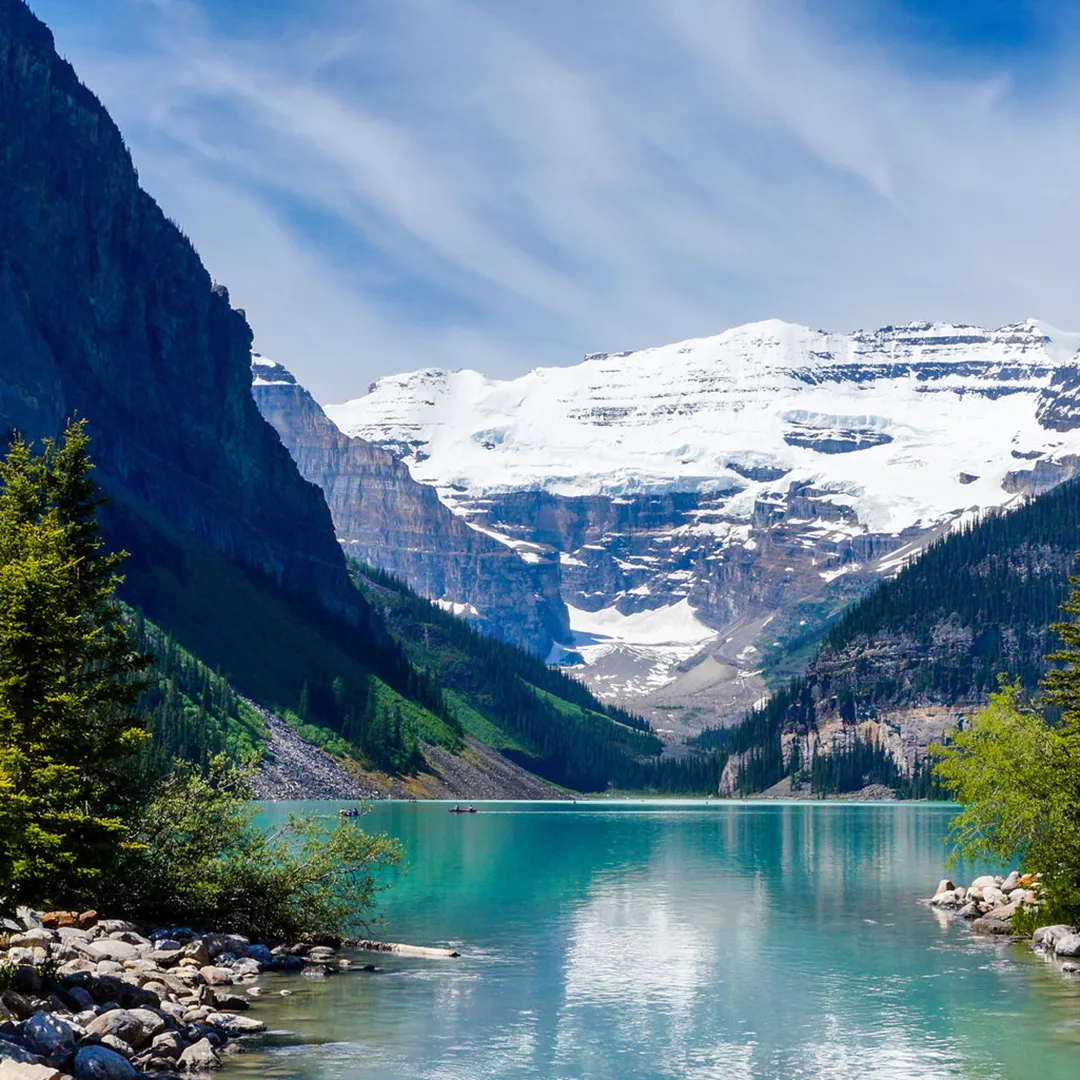
Lake Louise Canada
Lake Louise Canada
Canada
NORTH AMERICA
Yes
13
"The Canadian hamlet of Lake Louise is located in Alberta's Banff National Park. Located on the Bow River in Alberta's Rockies, 3 km (1.9 mi) northeast of the lake with the same name, it is named for Princess Louise, Duchess of Argyll. Originally established in 1884 as a Canadian Pacific Railway outpost, Lake Louise is Canada's highest community at 1,600 meters (5,200 feet) above sea level. The climate of Lake Louise is subarctic (Köppen climatic classification Dfc). The average annual snowfall is 279.1 cm (109.9 in), and while winter temperatures can drop below -50 °C (-58 °F), they often hover around -18.4 °C (-1.1 °F) in January and -17.6 °C (-0.3 °F) in February. Summers are characterized by chilly, crisp days and icy mornings. In each month of the year, snowfall is possible. It may also be referred to as a subalpine climate because lower elevations on that latitude have humid continental climates instead. The frost-free period is only 14 days on average due to the high altitude and significant diurnal air temperature change. According to Statistics Canada's 2011 Census of Population, Lake Louise had 691 residents.Workers in the tourism and service sectors frequently relocate to the area for employment, so the population frequently changes from year to year. While Highway 1A starts at the community's entrance, the Trans-Canada Highway (Highway 1) runs alongside the community. Just north of the village is the southernmost point of Highway 93, also known as the Icefields Parkway. The foothills of the Rocky Mountains, including what is now Lake Louise, were inhabited exclusively by local indigenous peoples before European settlers arrived. They hunted the once-common bison, as well as elk, moose, and other big and small game animals, as well as fished the area's abundant waterways and foraged the area's numerous edible and medicinal plant species. The Canadian Pacific Railway (CPR), which would pass through Bow Valley, started construction in the 1870s. The site was named 'Emerald Lake' by CPR worker Tom Wilson, who visited it in 1882 with a Nakoda guide. Afterwards, the hamlet was referred to as ""Holt City,"" ""Laggan,"" and finally, ""Lake Louise."" Although a CPR station from around 1890 was replaced in 1910, the railway company kept using it for other uses until 1976, when it was given to Calgary's Heritage Park Historical Village. The depot was relocated to the park and renovated in the manner of the time when the village was known as Laggan. Because of its excellent preservation and current use as a restaurant, the 1910 station was designated a heritage railway station by the federal government in 1991. Since its 1892 addition to Rocky Mountains Park, Lake Louise has grown to become a popular international tourist attraction thanks to its proximity to the Trans-Canada Highway.
Johannesburg Africa
Johannesburg Africa
South Africa
AFRICAN
Yes
39
Johannesburg is a city in South Africa's Gauteng province. It is the main financial and industrial center of the nation. Johannesburg, one of the newest big cities in the world, was established in 1886 after gold was discovered. Prior to becoming one of South Africa's four provinces, the city was a part of the Transvaal, an independent Afrikaner, or Boer, republic. Today, the city is a part of one of South Africa's nine provinces, Gauteng, which means "Place of Gold" in Sotho. The Highveld, a wide, grassy plateau that stretches across the interior of South Africa, is where Johannesburg is located. The city is situated on the edge of the Witwatersrand, also known as the Rand, which is a chain of low, rocky ridges that serves as a watershed between the drainages into the Atlantic and Indian seas. The city is between 5,700 and 5,930 feet (1,740 and 1,810 meters) above sea level. The climate of Johannesburg is moderate. The average temperature is around 75 °F (24 °C) in the summer and 55 °F (13 °C) in the winter, with very few periods below freezing. In both winter and summer, the city receives roughly eight hours of sunlight each day. Although the overall amount of rainfall fluctuates greatly from year to year, it averages around 28 inches (700 millimeters) annually. A major location for several creative and cultural industries, Johannesburg is a cultural center in South Africa with a diverse range of cultural venues. In addition to a plethora of other museums, theaters, galleries, and libraries, Johannesburg is home to the South African Ballet Theatre, the National School of Arts, and the University of Witwatersrand's School of the Arts.The Central Business District of Johannesburg is home to the Johannesburg City Library. The city is home to a number of Premiership and National First Division football teams. The top Johannesburg teams in the Premiership, such as Orlando Pirates (also known as the Buccaneers) and Kaizer Chiefs (also known as Amakhosi), are bitter rivals. They are headquartered at the Orlando and FNB stadiums in the city. Soccer City, the site of the 2010 FIFA World Cup final, hosts a number of major league and cup matches. FC AK and Jomo Cosmos are the teams in the First Division. The stadiums used by Katlehong City and Alexandra United are Alexandra and Reiger Park, respectively.


 (1).jpg)

.jpg)
.jpg)



.jpg)