French Riviera France
French Riviera France
France
EUROPE
Yes
26
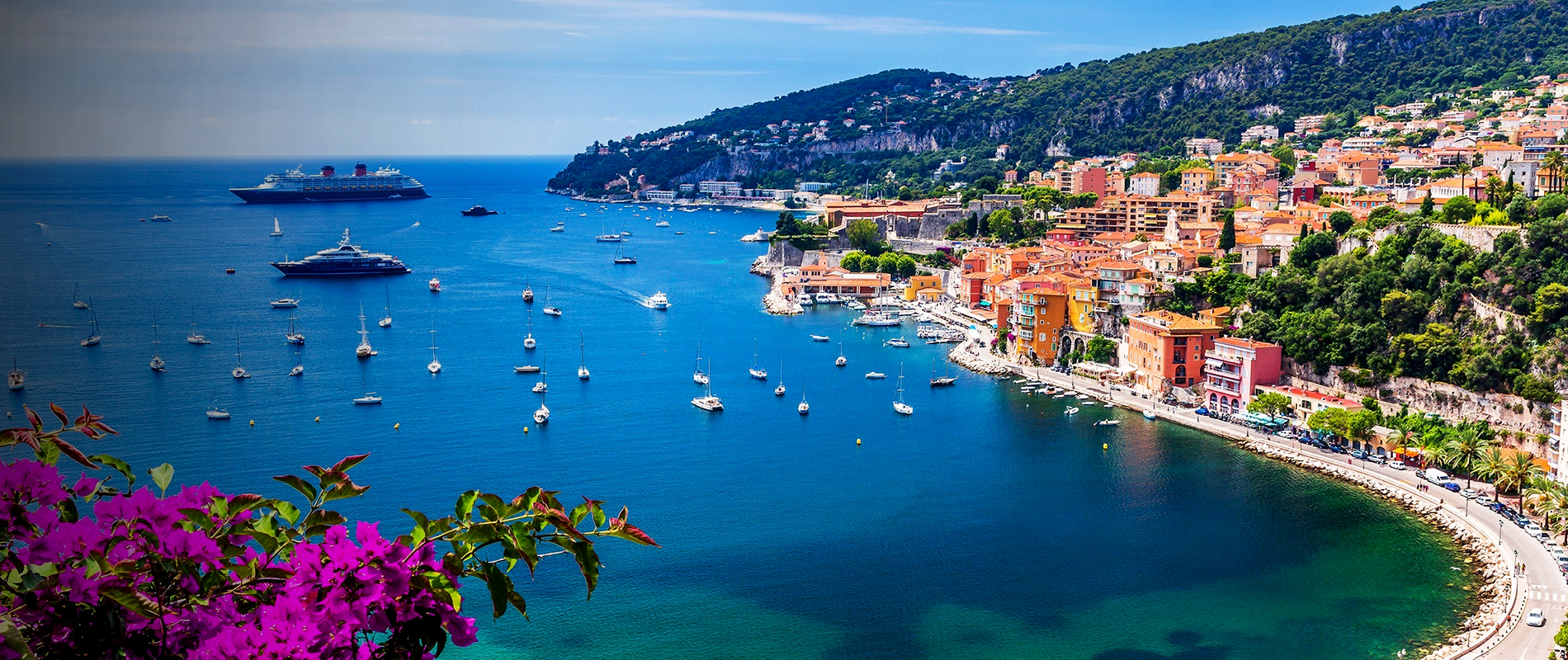
"The southeast coast of France's Mediterranean region is known as the French Riviera. Though some sources place the western boundary further west around Saint-Tropez or even Toulon, it is generally accepted to be the coastal region of the Alpes-Maritimes department, extending from the rock formation Massif de l'Esterel to Menton, at the France–Italy border. The Provence-Alpes-Côte d'Azur area of France encompasses the entire coast. The Principality of Monaco, which faces the Mediterranean and is surrounded by France on three sides, is a semi-enclave in the area. The French Riviera is home to the coastal cities of Cap-d'Ail, Beaulieu-sur-Mer, Saint-Jean-Cap-Ferrat, Villefranche-sur-Mer, Antibes, Juan-les-Pins, Cannes, and Théoule-sur-Mer. The name ""riverside"" comes from the old Ligurian region of Italy, which is situated between the Var and Magra rivers. France originally dubbed the County of Nice ""Côte d'Azur"" after it was annexed in 1860 because of the region's climate, which was ""a sky as blue as its sea"" and comparable to that of northern Italy, even during the winter. Summer temperatures in the Mediterranean can be quite cold when the Mistral (Northwest) and Tramontane (North) winds are blowing in the Languedoc and Provence regions. On the shore between the French and Italian Rivieras, this phenomena is either hardly noticeable or nonexistent. The Italian Riviera, which stretches east of the French Riviera (from Ventimiglia to La Spezia), is analogous to the French Riviera.The eastern portion of the coast, between Monaco and the Italian border, was commonly referred to as the French Riviera or the Riviera by the British as early as the 19th century. ""Coastline"" is what the Italian term ""river"" signifies. There are no formal borders between the French Riviera and Côte d'Azur. According to some sources, Saint-Tropez marks the western limit. Other locations include Cassis in the Bouches-du-Rhône department, Saint Tropez, Hyères, or Toulon in the Var department. Patricia Highsmith defines the Riviera as the entire coastline between Toulon and the Italian border in her 1955 book The Talented Mr. Ripley. People have lived in the French Riviera region since the beginning of time. In the Grotte du Vallonnet, close to Roquebrune-Cap-Martin, prehistoric artifacts from between 1,000,000 and 1,050,000 years ago were found with animal bones and stones, including those of bison, rhinoceroses, and cows. One of Europe's oldest fireplaces was uncovered at Terra Amata (380,000 to 230,000 years ago), close to the Nice Port.
Cape Town
Cape Town
South Africa
AFRICAN
Yes
35
South Africa's legislative capital is Cape Town. It is the oldest city in the nation and the location of the South African Parliament. Cape Town is the largest city in the Western Cape and the second most populous city in the nation, after Johannesburg.The city is a part of the metropolitan municipality known as the City of Cape Town.Table Mountain, Cape Point, the city's harbor, and its natural environment in the Cape Floristic Region are some of its most well-known features. Numerous publications have ranked Cape Town as the world's greatest city and the finest place to go, including Time Out in 2025, The New York Times in 2014, and The Telegraph for the last eight years (2017–2025). With the greatest concentration of Cape Dutch-style buildings worldwide, Cape Town is renowned for its architectural legacy. Constantia, the historic government buildings in the Central Business District, and Long Street are the best examples of the Cape Dutch architectural style, which blends the architectural traditions of the Netherlands, Germany, France, and Indonesia. Mostert's Mill in Mowbray is the only fully operational windmill in South Africa. Constructed in 1796, it underwent restorations in 1935 and 1995. In 2014, the International Council of Societies of Industrial Design declared Cape Town the World Design Capital. Additionally, Cape Town is designated a "Design City" by the Creative Cities Network of UNESCO. Cape Town's biggest performing arts facility is the Artscape Theatre Centre. The 17th-century savory, sweet, spiced beef dish known as bobotie is one of the foods that originated in Cape Town or is associated with it. A sandwich stuffed with slap chips and other toppings, the Gatsby was initially offered in the Athlone area in 1976 and has since come to represent the city.A classic Cape Malay dessert, the koe'sister is characterized as a cake-like dumpling flavored with cinnamon and topped with a dusting of desiccated coconut. Table Mountain's mass and the chilly Benguela Current of the South Atlantic Ocean both locally alter Cape Town's Mediterranean climate. While the average high temperature is 70°F (21°C) in January and February and the average low temperature is 55°F (13°C) in July, the coast and mountain slopes experience colder weather. Freezing rarely happens. Rainfall occurs on 69 days of the year on average; the southern winter months of June through August account for roughly half of the 26 inches (660 millimeters) of yearly rainfall. Every year, almost five million tons of goods pass through the port of Cape Town. Although ships with a draft of more than 40 feet are not permitted to enter the port during low tide, interoceanic commerce benefits greatly from its dry dock and maintenance facilities. Container traffic is accommodated at the Ben Schoeman Dock.


 (1).jpg)

.jpg)
.jpg)



.jpg)